
The deadline is a gate, not a finish line
The submission deadline feels like the finish line. It is closer to the starting gun. A submitted SBIR proposal enters a defined sequence: an administrative screen, a technical evaluation, a selection decision, a notification, and, for the proposals that clear each gate, a negotiation that ends in an award. Each stage has its own reviewers, its own criteria, and its own clock. Knowing the sequence turns the quiet weeks after submission from anxiety into planning.
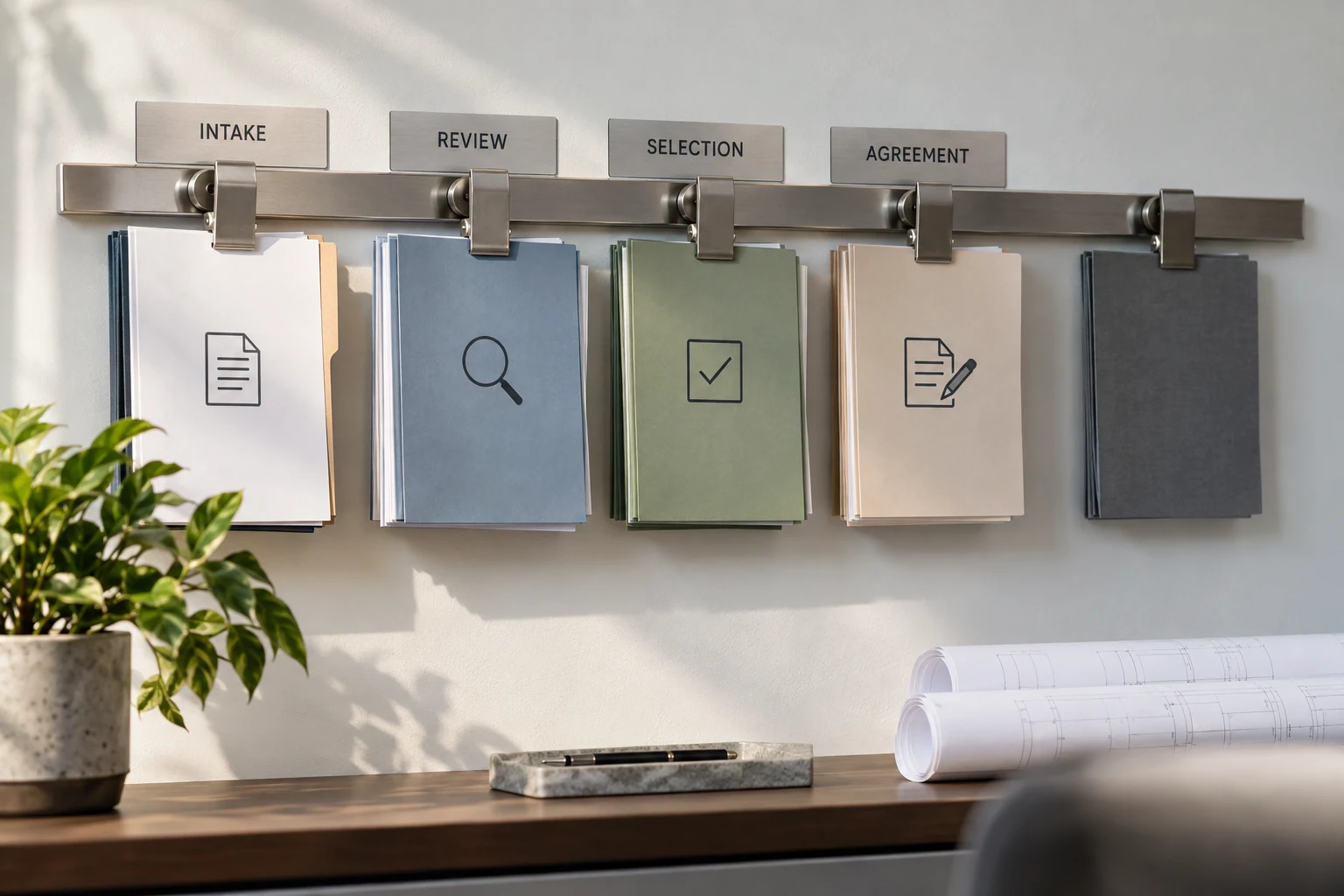
When the submission window closes, evaluation begins on a schedule the government controls. For most Defense components, policy calls for a select or non-select notification within roughly 90 days of the close; in practice several programs move faster, and the Army has published averages in the range of 30 to 50 days. Civilian agencies run their own calendars. The same proposal can read as "Submitted," then "Under Review," then "Selected" or "Not Selected" at different points on that pipeline without anyone contacting the offeror in between.
The stages are consistent across agencies even when the names and timelines differ. Understanding what each stage does explains why the wait is long, why silence is normal, and where a proposal is most likely to fall out.
Submission to award — the sequence
Durations are typical working expectations. The governing solicitation and the portal status field are the authorities for any given submission.
How long the wait typically runs
Timelines vary by agency family, and every window below is a typical range, not a guarantee. Defense components work to a policy target near 90 days from the close of the window, and several programs notify well inside it. Civilian research agencies that run peer-review and advisory cycles take longer. Open-innovation pathways are the fastest. The table gives working expectations; the solicitation and the portal are the authorities.
| Program family | Typical decision window | What sets the pace |
|---|---|---|
| Defense components | ~30–90 days after close | Policy target near 90 days; some programs notify sooner |
| Open-innovation / commercial-solutions calls | Weeks to ~2 months | Rolling or pitch-style review, shorter proposals |
| NIH | ~4–8 months | Two-tier peer review plus advisory council cycle |
| NSF | ~3–6 months | Merit review of the pitch and full proposal |
| DOE and other civilian | ~3–6 months | Program-office technical and administrative review |
The compliance screen — what gets filtered first
Before a single evaluator judges the merit of the work, an administrative screen checks whether the proposal is allowed to be evaluated at all. This screen is mechanical and unforgiving. It confirms that every required volume and form is present, that page and font limits are respected, that registrations are current, and that the proposal is responsive to the subject area it answers. Proposals that fail are returned without technical review. Published estimates put the share that wash out at this step in the range of five to ten percent, a large number of proposals eliminated for reasons that have nothing to do with the quality of the idea.
Completeness. Every volume the solicitation requires is attached and in the correct slot. A missing cost volume or commercialization section can end the review before it begins.
Formatting. Page count, margins, font size, and file type are checked against the letter of the solicitation. One page over the limit is still over the limit.
Registrations. SAM.gov, the SBIR company registration, and any portal-specific accounts must be active and consistent. Lapsed or mismatched records stop a submission cold.
Responsiveness. The proposal has to answer the subject area it was filed against. A strong idea submitted against the wrong subject area is non-responsive and does not reach a reviewer.
How evaluators are assigned and what a panel does
A proposal that clears the screen is routed to reviewers with subject-matter expertise in the problem class. Depending on the agency, that means government technical staff, a mix of government and contractor support reviewers under nondisclosure, or an external peer panel. Most programs assign more than one evaluator to a proposal so that no single reader's judgment decides the outcome.
Each evaluator scores the proposal against the published criteria independently, then the scores and written comments are consolidated. The panel is not looking for a perfect document. It is looking for a credible technical approach, a work plan that fits the phase, a team that can execute, and a plausible path to a customer. Reviewers write comments as they read, and those comments become the raw material for the feedback an offeror can later request.
How reviewers weight a proposal — typical emphasis
Illustrative emphasis only. Exact weights and their order are set by each solicitation; read the criteria before writing.
Adjectival ratings and numerical scores — two ways to say the same thing
Agencies express evaluation results in one of two vocabularies. Some assign numerical scores against weighted criteria and rank proposals by total. Others use adjectival ratings such as Outstanding, Good, Acceptable, Marginal, and Unacceptable, sometimes paired with a confidence or risk rating. The two systems are close cousins. A numerical rank and an adjectival ladder both sort proposals into a fundable band and an unfunded remainder.
The criteria behind either vocabulary are consistent. Technical merit and innovation carry the most weight, commonly close to half of the score. The qualifications of the principal investigator and team, and the commercial or transition potential of the work, split most of the rest. Cost realism and responsiveness round out the picture. An offeror who reads the solicitation's criteria and their weights knows, before writing a word, where the points are.
"Competitive but not selectable" — the phrase that stings
The hardest result to absorb is a proposal that scores well and still does not get funded. Every agency funds from a fixed pool. When the number of strong proposals exceeds the money available, the selection line falls somewhere inside the "good" band, and creditable proposals below that line are declined. "Competitive but not selectable" is the language for this outcome: the work was rated well, the reviewers found no disqualifying flaw, and there simply was not enough money to reach it.
Reading that result correctly matters. It is not a verdict that the idea is weak. It is a signal that the proposal was near the line and that a modest improvement, or a submission into a less crowded program, could tip it.
Why open-topic pathways move in weeks and conventional calls take months
Not every SBIR decision runs the full multi-month calendar. Open-innovation pathways and commercial-solutions style calls are built for speed. They use rolling or batched review, shorter proposals, smaller evaluation panels, and in some cases a pitch-style event where a decision follows the presentation by a short interval. In practice, these pathways commonly reach a decision in weeks rather than the months a conventional solicitation takes.
The trade is real. Faster pathways ask the offeror to arrive with a mature concept and, often, an identified government customer, because there is no long runway to develop those relationships during review. Conventional solicitations move slowly in part because they evaluate many proposals against a narrowly defined problem class, consolidate multiple reviewers, and route selections through a longer approval chain. Speed and structure trade against each other, and knowing which pathway a submission is on sets the right expectation for the wait.
What a selection notification commits the government to
A selection notification is good news, and it is also frequently misread. Selection is a notice of intent to negotiate an award. It is not the award, and it is not a signed contract. Between selection and award, the government completes administrative steps: cost negotiation, verification of registrations and eligibility, and internal approvals. Funding is obligated at award, not at selection.
This distinction has practical weight. A selected firm should not hire against the money, sign obligations that assume it, or announce a contract that does not yet exist. The gap between selection and award is usually weeks, occasionally longer, and in rare cases a selection is withdrawn before award for reasons ranging from funding changes to eligibility questions. Treat selection as a strong commitment to proceed, not as cash in hand.
The silence period — why the portal beats the inbox
The stretch between submission and notification is quiet by design. Evaluators are under nondisclosure, contracting officers cannot preview outcomes, and there is rarely any status a program manager can share mid-review that has not already been published. Emailing to ask where a proposal stands mid-evaluation seldom produces new information and can read as not understanding the process.
The portal is the system of record. For Defense submissions that is DSIP, where the status field moves through its own sequence and updates when a stage completes. Checking the portal answers the only question that has a real answer during the wait: has the status changed. When it changes to a decision, the notification and any feedback follow through the same system. Watch the record, not the inbox.
Should I email the program office to check on my proposal?
Generally no. Evaluators are under nondisclosure and there is rarely a status to share mid-review. Check the portal status field instead; it is the system of record and it updates when a stage completes.
Does "Under Review" mean someone is reading it right now?
Not necessarily. The status reflects the stage a proposal has reached in the pipeline, not real-time activity. A proposal can sit in the same status for weeks while the panel works through a large field.
Can I submit the same idea to another agency while I wait?
Often yes, provided you disclose concurrent or prior submissions where the forms ask. The rules on essentially equivalent work are specific; read the solicitation and answer the certifications truthfully.
How long after selection does the money actually arrive?
Usually a few weeks of negotiation and administrative steps between selection and a signed award. Funds are obligated at award, so plan cash flow from the award date, not the selection date.
Reading a decline — what a debrief entitles you to
A non-selection is not the end of the conversation. Most agencies provide feedback, and many Defense components now attach a short written explanation to a "Not Selected" status. Beyond that, an offeror can generally request the evaluators' written comments. The comments are organized around the evaluation criteria, and each one is a coded signal that a section fell short of what reviewers expected.
Read a debrief structurally, not emotionally. Map every comment to the criterion it addresses and to the exact place in the proposal it points at. A comment about "unclear technical risk" is an instruction to rewrite the risk section, not a matter of taste. Feedback rarely lists every flaw, so treat the comments as the most important issues rather than a complete audit. The goal of reading a debrief is a specific, ranked list of what to change.
How a decline should feed the next submission
The firms that win consistently treat every decline as an input to the next proposal. A debrief converts a loss into a punch list. Weak technical framing, a thin commercialization case, an under-qualified team section, or a cost volume that raised questions each map to a concrete revision. The same core idea, resubmitted into the next cycle with the reviewers' objections answered, is a materially stronger proposal than the first attempt.
There is a discipline to it. Keep the reviewer comments, tag them by criterion, and carry the pattern across submissions, because the same weakness tends to recur until it is fixed at the root. A proposal history read this way becomes a training set. Over enough cycles the win rate climbs, not because the ideas got luckier but because the proposals stopped losing points in the same predictable places.
Frequently asked questions
It depends on the agency. Defense components generally work to a target near 90 days from the close of the submission window, and some notify inside 30 to 50 days. Civilian research agencies that run peer review and advisory cycles commonly take several months. Treat any figure as typical, not promised.
The proposal was rated well and had no disqualifying flaw, but the agency ran out of funding before reaching it. It is a near-miss, not a judgment that the idea is weak, and it is usually worth revising and resubmitting.
No. Selection is a notice of intent to negotiate an award. The contract exists, and the money is obligated, only after negotiation and the government's administrative steps are complete. Do not commit funds against a selection.
Generally no. Evaluators are under nondisclosure and there is rarely a status to share mid-review. The portal is the system of record; check the status field there rather than emailing.
Most agencies provide feedback, and many Defense components attach a short explanation to a "Not Selected" status. You can usually request the evaluators' written comments, organized by criterion. Read them as a ranked list of what to fix.