
Cost is not scored — but it still sinks proposals
Cost proposals in SBIR are evaluated for reasonableness and realism, not scored competitively. A proposal at the ceiling and one at 90% of the ceiling are treated the same if both are well-justified. What does hurt: unsupported indirect rates, labor categories that do not match the technical plan, travel numbers that do not align with the SOW, and consultant costs that exceed the solicitation's cap.
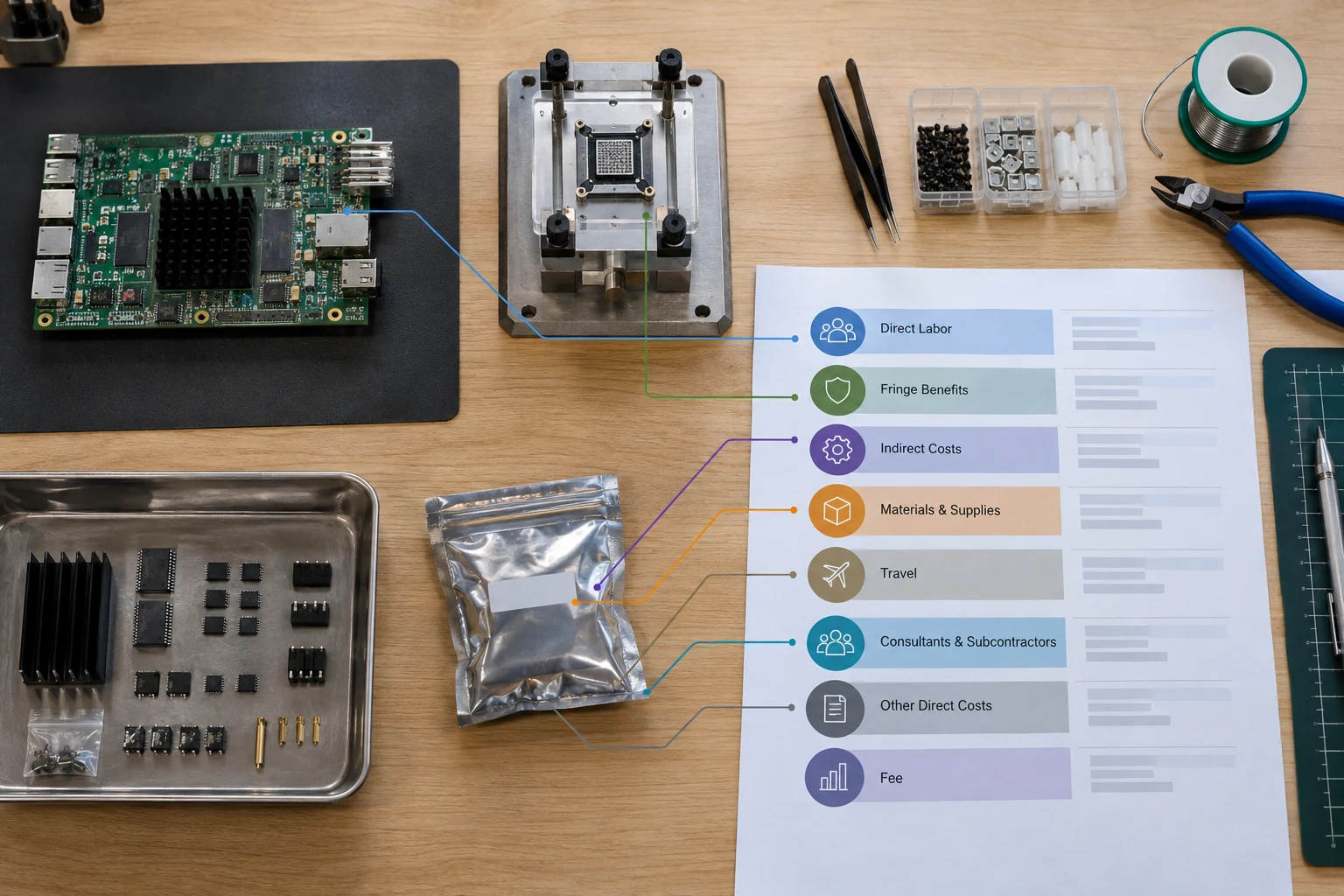
A cost proposal that triggers a hold from the contracting officer can delay award by 30-90 days or, in the worst case, cause the agency to move on to the next selectable proposal. The cost proposal does not win awards, but it can lose them.
SAMPLE PHASE I BUDGET — BREAKDOWN BY COST ELEMENT
Values shown as percent of total budget. Fee is 9% of cost base but reads as ~3% of total.
Direct labor — the core
Direct labor is usually 60-75% of a Phase I budget. The structure is labor category × hours × loaded rate. Labor categories should match the technical plan: if the SOW has 200 hours of senior ML engineering, the budget must show those 200 hours under a senior ML engineer category at a rate that matches published federal benchmarks for that category.
| Labor category | Typical Phase I hourly (fully loaded) | Notes |
|---|---|---|
| Principal Investigator | $180-$250 | PI rate reflects expertise. DCAA will benchmark against federal salary data. |
| Senior ML / Software Engineer | $140-$200 | 5-15 years experience. Matches SCA and prior federal benchmarks. |
| Mid-level Engineer | $100-$150 | 2-5 years experience. |
| Junior Engineer / Research Assistant | $60-$100 | Entry-level technical. |
| Program Manager | $120-$180 | Cap PM hours — most Phase Is show 5-10% PM. |
Fringe benefits
Fringe is a separate line that covers employer payroll taxes, health insurance, retirement, PTO. Typical fringe rates run 25-35% of direct labor. A new firm that has not set fringe formally can use a provisional rate based on actual paid benefits. Document the calculation in the cost narrative: "Fringe rate of 28% is based on employer FICA (7.65%), health insurance (12%), retirement match (5%), PTO accrual (3.35%)."
Indirect rates — the most scrutinized line
Indirect costs cover everything that is not directly billable to a project: rent, utilities, general administration, accounting, business development, bid and proposal. For SBIR purposes, indirect is typically split into overhead (applied to direct labor) and G&A (applied to total cost input).
For a new firm, indirect rates are provisional — you propose a rate, the CO accepts it subject to later audit. Typical provisional rates for small firms: overhead 20-40%, G&A 10-20%. Both are defensible if justified; both can be challenged. See our indirect rates deep dive for the full treatment.
If the firm has a NICRA (Negotiated Indirect Cost Rate Agreement) from a prior federal contract or DCAA audit, use it. A NICRA-backed rate is accepted without question.
Fee and profit
SBIR Phase I fee is typically capped at 7-9% of total cost input (TCI = direct + indirect). Phase II fee cap is similar. Fee is not overhead — it is the firm's profit margin on the contract. Propose at the cap; there is no reward for proposing less.
Phase III is different. Phase III is commercial pricing, not cost-plus, so "fee" does not apply in the same sense. See our Phase III playbook.
Materials and supplies
Materials are direct-charged items consumed in the project: compute credits, dataset licenses, software subscriptions specific to the work, lab supplies if applicable. For an AI project, materials are usually cloud compute ($5-20K for Phase I), dataset licenses if purchased, and development tooling that is project-specific. General-purpose software licenses belong in indirect, not direct.
Travel
Travel is direct-charged at per diem rates (GSA publishes). Typical Phase I travel: 2-4 trips for kickoff, mid-review, and final review. Budget $1,500-$3,000 per trip for domestic. Large travel numbers draw scrutiny — justify each trip in the cost narrative with purpose and duration.
Consultants and subcontractors
SBIR restricts how much of the award can go to consultants and subcontractors. Phase I: no more than 33% of total award. Phase II: no more than 50%. Academic subcontractors (common for AI work) count toward the cap. Exceeding the cap requires a waiver, which is rare.
Consultant rates are the consultant's billing rate, not a cost buildup. Most agencies cap consultant rates at a published federal benchmark (typically 120% of the Executive Schedule Level II, roughly $1,400/day in 2026).
Other direct costs (ODC)
Anything direct-charged that is not labor, fringe, materials, travel, or consultant. Common ODCs on AI projects: FedRAMP cloud environment setup, specialized data acquisition, publication fees. Keep this line small and justified.
Cost narrative — where justifications live
Every line in the cost proposal needs a one-paragraph narrative that explains the basis: why this rate, why this many hours, why this cost. A strong cost narrative reads like the engineering lead wrote it with a procurement person looking over their shoulder — technical enough to be credible, formal enough to pass DCAA scrutiny.
Common cost proposal errors
- Hours don't match SOW. Technical volume says 6 months of full-time engineering; budget shows 400 hours. CO flags the mismatch.
- Rate without basis. Senior engineer at $275/hr with no salary survey or prior contract to back it.
- Subcontractor cost exceeds the cap. Phase I with 40% to a university subcontractor. Rejected.
- Fee exceeds the cap. 10% fee on DoD Phase I (cap is 7%). Automatic hold.
- Travel without detail. "$6,000 travel" with no trip breakdown. CO asks, proposal sits.
- Missing SBC registration. Not a cost issue per se, but the cost proposal won't process without current SBC registration.
Frequently asked questions
Typically 7-9% of total cost input depending on agency. DoD is usually 7%, NIH up to 7%, NSF up to 7%. Check the solicitation.
No. Provisional rates are accepted on Phase I and Phase II. A NICRA becomes valuable when contract volume grows.
Phase I: 33% of total award max. Phase II: 50% max. Academic subcontractors count.
For a new firm: overhead 20-30%, G&A 10-15% are defensible. Higher rates require documentation of actual costs.
No — cost is evaluated for reasonableness, not scored. But unsupported costs can cause holds or declinations.
Yes, at a defensible PI rate. The PI must dedicate minimum hours per agency rules (typically at least one calendar month of effort in Phase I).