
Why worked examples matter
Cost proposal templates exist on every agency website, but they tell you the fields to fill, not what to write in them. A first-time SBIR firm looking at a blank cost proposal spreadsheet often makes the same mistake: they pad the hours, leave the indirect line unsupported, and submit a cost narrative that does not tie back to the technical SOW. This piece walks three worked examples — a $150K Phase I, a $250K Phase I (at the current DoD ceiling), and a $1.8M Phase II — so the structure is concrete, not hypothetical.
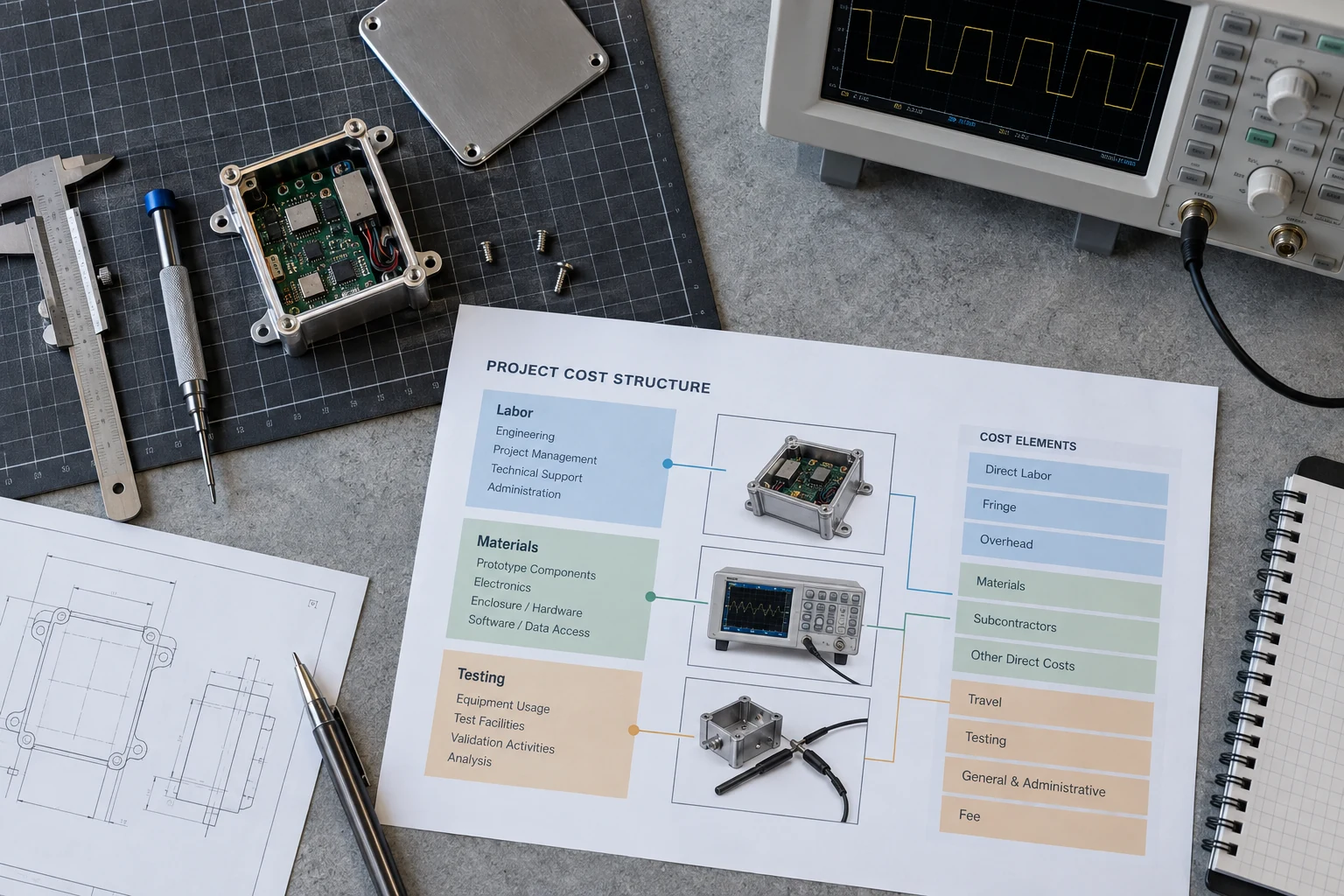
- Step 1 — Direct labor: List all personnel with hours × loaded rate. Rates must match your DCAA-approved rate agreement or provisional rates.
- Step 2 — Fringe + overhead: Apply approved indirect rates to direct labor base. Show the math — auditors check the arithmetic.
- Step 3 — Subcontractors: Attach quotes or SOW excerpts for any sub above $150K. Cost analysis required above simplified acquisition threshold.
- Step 4 — Other direct costs: Travel, materials, equipment. Each line needs a performance justification, not just a dollar amount.
- Step 5 — Fee: Capped at 7% for Phase I SBIR (DoD). Apply to total direct + indirect costs, not G&A base.
WHAT DoD REVIEWERS ACTUALLY SCRUTINIZE IN A BUDGET
Editorial weighting from public sources and practitioner reading — illustrative, not a measured statistic.
Weights reflect how often each line triggers a hold or clarification request at DoD COs during award negotiation.
Example 1 — $150K Phase I (NSF)
The NSF Phase I ceiling is $305K as of 2026 (NSF 26-510), inclusive of all costs and fee; many firms still propose below the ceiling for focused feasibility work. The structure:
| Line | Amount | Basis |
|---|---|---|
| Direct labor | $72,000 | PI 300h @ $180, Senior Eng 200h @ $150, Junior Eng 150h @ $80. Total 650 hours. |
| Fringe (28%) | $20,160 | Employer FICA, health, retirement, PTO. |
| Overhead (25% of labor+fringe) | $23,040 | Rent, utilities, admin, accounting. |
| Materials | $6,000 | Cloud compute $4K (AWS GPU), dataset license $2K. |
| Travel | $3,500 | One kickoff trip, one final review trip, GSA per diem. |
| Subcontract (academic) | $12,000 | University collaborator, 80 hours at $150/h loaded. |
| G&A (10%) | $13,670 | Applied to total cost input. |
| Subtotal | $150,370 | Total cost before fee. |
| Fee (7%) | — | Excluded here for NSF (NSF generally does not allow fee on Phase I). |
| Total | $150,370 | Round to $150K for clean submission. |
Cost narrative excerpt: "Direct labor of 650 hours supports SOW Tasks 1-4 as described in the technical volume. Task 1 (data acquisition, 100 hours) is performed primarily by the Senior Engineer with oversight from the PI. Task 2 (model development, 250 hours) is split across PI and Senior Engineer. Task 3 (evaluation, 200 hours) adds the Junior Engineer. Task 4 (final report and deliverable, 100 hours) is led by the PI. The academic subcontract supports Task 2 by providing access to a specialized evaluation dataset not otherwise available..."
Example 2 — $250K Phase I (DoD ceiling)
DoD raised the Phase I ceiling to $314K in recent cycles; many components still fund at $250K. Structure for a $250K award with 7% fee:
| Line | Amount | Basis |
|---|---|---|
| Direct labor | $118,000 | PI 400h @ $200, Senior Eng 400h @ $160, Mid Eng 300h @ $110, PM 80h @ $140. |
| Fringe (30%) | $35,400 | Employer taxes, benefits, PTO. |
| Overhead (28%) | $42,952 | Applied to labor+fringe. |
| Materials | $12,000 | Cloud compute (secured enclave), data access fees. |
| Travel | $5,500 | Kickoff + mid-review + final (3 trips, GSA per diem). |
| Consultants | $8,000 | Domain expert, 50 hours at $160 capped. |
| ODC | $3,000 | FedRAMP environment setup fees. |
| G&A (12%) | $26,980 | Applied to total cost input. |
| Subtotal (TCI) | $251,832 | Adjust labor hours to land clean. |
| Fee (7%) | — | Add as allowed; many firms cap total at ceiling after fee. |
DoD cost proposals require more documentation than civilian: subcontractor cost detail, consultant letter with rate basis, and provisional indirect rate documentation. Attach a cost narrative that runs 4-6 pages; DCAA can and does ask for expansion.
Example 3 — $1.8M Phase II (DoD)
A 24-month Phase II at the typical DoD funding level. Structure:
| Line | Amount | Basis |
|---|---|---|
| Direct labor | $820,000 | 5 FTEs over 24 months, blended rate ~$170 loaded, ~4,800 hours. |
| Fringe (30%) | $246,000 | Applied to direct labor. |
| Overhead (30%) | $319,800 | Applied to labor+fringe. |
| Materials | $80,000 | Cloud compute (~$3K/mo over 24 mo), dataset licenses, test harness hardware. |
| Travel | $30,000 | Quarterly reviews, conferences, customer meetings. |
| Subcontracts | $180,000 | University partner + integration subcontractor. 10% of total, well within 50% cap. |
| ODC | $20,000 | ATO/FedRAMP support, publication, security review. |
| G&A (12%) | $204,696 | On total cost input. |
| Subtotal | $1,900,496 | Adjust to land at $1.8M after fee. |
| Fee (7%) | included above | Typically applied to TCI. |
A Phase II cost proposal lives or dies on the labor plan. Show a loading chart by month, by labor category, tied to the task-month matrix in the SOW. A CO looking at the Phase II should be able to reconcile every hour to a specific task in a specific month.
Attachments the CO wants
- Cost narrative (5-10 pages for Phase II)
- Labor loading chart by month and category
- Subcontract cost proposals (full, not summary)
- Consultant letters with rate basis
- Indirect rate documentation (provisional or NICRA)
- Fringe rate calculation
- Travel detail (purpose, destination, duration, per diem basis)
- Materials detail (vendor quotes for significant items)
What triggers a hold
A hold on the cost proposal — where the CO pauses the award pending clarification — is common and usually resolvable in 2-6 weeks. Triggers include: indirect rate without documentation, subcontract cost structure missing, consultant rate exceeding cap without waiver, travel without detail, or labor hours that do not reconcile to the SOW. Most holds are clerical; a few signal structural problems that can ultimately cost the award.
Frequently asked questions
A paragraph per line item explaining basis: hours tied to SOW tasks, rates tied to salary or survey data, materials tied to vendor quotes, travel tied to specific trips.
Down to labor category and task, ideally loaded by month for Phase II. Phase I can be less granular but should still show which category does which task.
Generally no — B&P is an indirect expense recovered through overhead, not a direct charge.
Document it. A 40% overhead rate is defensible if the firm can show the cost build. Unsupported high rates get challenged.
For significant materials (>$5K), yes. For cloud compute, a calculation showing GPU hours × rate is sufficient.
Typically not in Phase I. Phase II awards over $1M can trigger audit scrutiny. Firms regularly get audited 2-3 years after their first award.