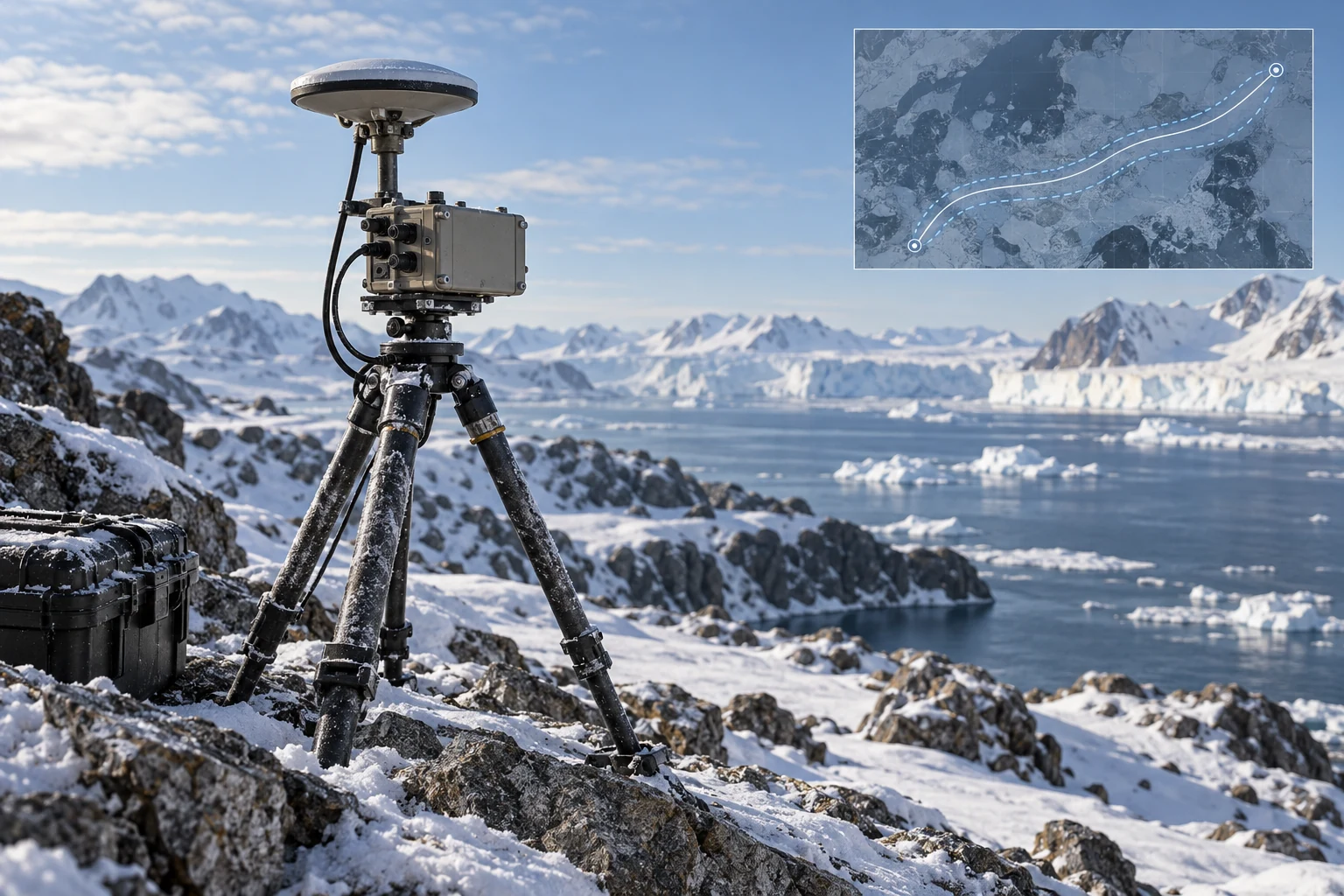
 AI-generated conceptual illustration
Editorial weighting from public sources and practitioner reading — illustrative, not a measured statistic.
Higher score = stronger published methodological discipline for polar PNT software.
Why polar regions are special

Polar regions present a distinctive PNT environment. GNSS satellite geometry is degraded near the poles. Magnetic compasses behave anomalously near the magnetic poles and across the auroral oval. Visual cues for traditional navigation are limited by terrain and weather. Several public DoD and Coast Guard documents describe the operational consequences. The publicly available methods literature on polar PNT is thinner than the temperate-latitude literature but has grown substantially in the last decade.
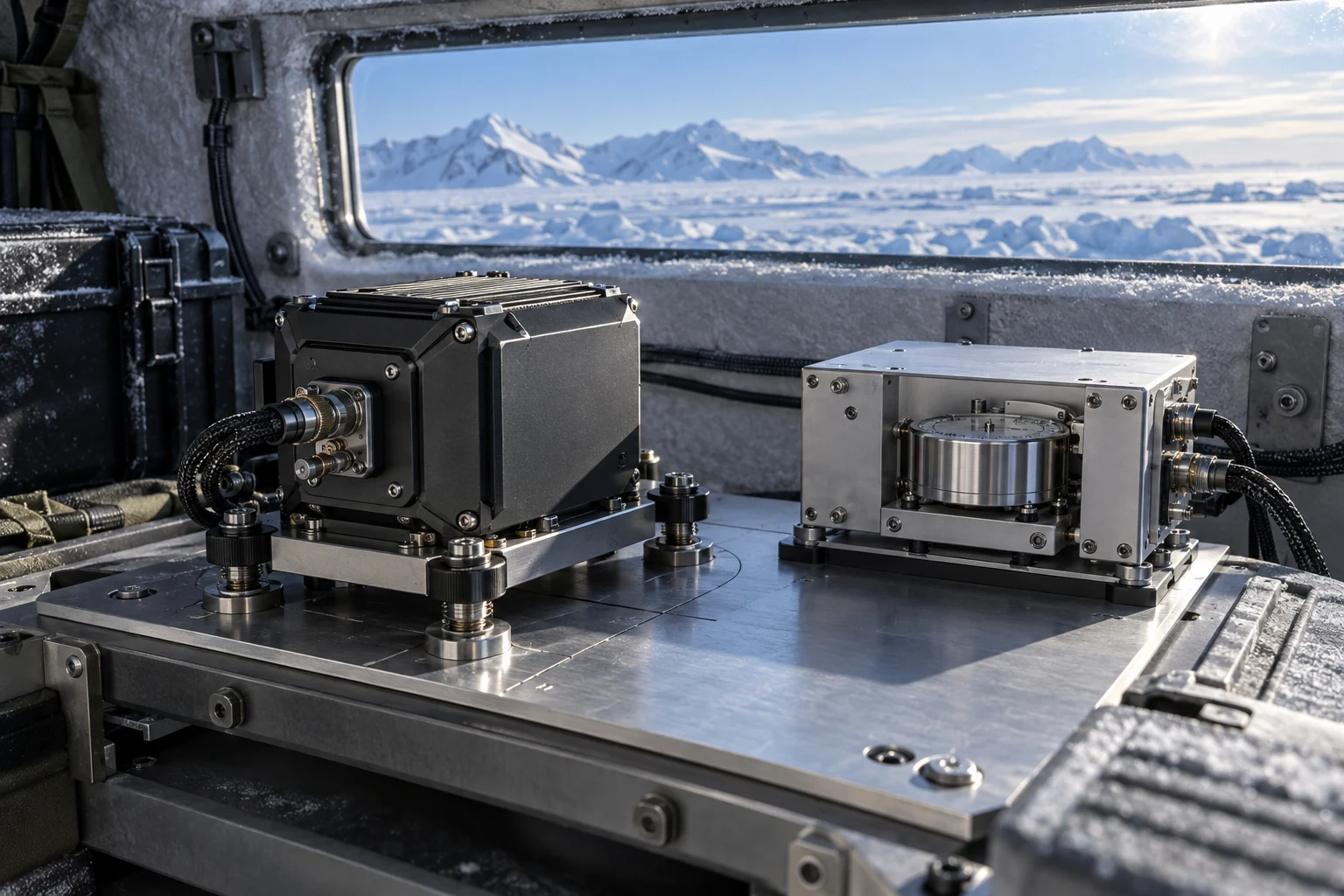
Polar regions degrade GNSS geometry and disrupt magnetic compasses. Multi-sensor fusion — celestial, signals of opportunity, inertial — extends bounded-error intervals at acceptable accuracy.
Magnetic compass corrections
Magnetic deviation, declination, and the anomalous behavior near magnetic poles are well-modeled by the World Magnetic Model (WMM), maintained jointly by NOAA's National Centers for Environmental Information and the British Geological Survey, with five-year update cycles and out-of-cycle corrections when secular variation requires them. The companion Enhanced Magnetic Model (EMM) and the International Geomagnetic Reference Field (IGRF) provide finer-resolution alternatives for specific use cases. Modern systems combine WMM-corrected magnetic readings with other sensors; pure magnetic compasses are not used as primary in polar operations.
The methodological literature has good coverage of magnetic-inertial fusion for high-latitude conditions, including extended-Kalman-filter formulations that incorporate the spatial gradient of the magnetic field, factor-graph approaches popularized in robotics by Dellaert and Kaess, and learned residual models that absorb local anomalies after the WMM correction. Published evaluations from the U.S. Coast Guard and the Naval Postgraduate School consistently report that magnetic-inertial fusion under WMM correction provides usable heading at latitudes well into the auroral oval, with degraded performance during geomagnetic disturbances tracked by NOAA's Space Weather Prediction Center.
Operationally, the limiting factor is rarely the WMM accuracy but the calibration of the on-platform magnetic environment. Hard-iron and soft-iron biases from the platform itself dwarf the WMM residual error in most cases. The published self-calibration methods — figure-eight maneuvers, online ellipsoid fitting, and learned bias correction conditioned on platform state — are well established and are part of standard navigation-system bring-up.
Celestial techniques
Celestial navigation, including modern automated star trackers and sun sensors, works in polar regions when atmospheric conditions allow. The published methods include star-pattern matching against catalogs such as the Hipparcos, Tycho-2, and Gaia DR3 catalogs, astronomical refraction correction using temperature and pressure profiles, and integration with inertial measurements through tightly-coupled filters. For surface vessels and aircraft, electronic celestial navigation has become a viable backup to GNSS, with several recent academic and DoD-funded papers — including AFRL and Naval Research Laboratory publications — documenting accuracy limits in the meters-to-tens-of-meters range under good observing conditions.
Polar conditions impose specific challenges. Long polar nights provide extended star-tracking windows but introduce thermal management challenges for sensor optics. Polar days reduce contrast and limit star availability while extending sun-sensor utility. Polar atmospheric conditions — ice fog, blowing snow, low solar elevation — degrade observability in ways that the published refraction models capture imperfectly. Practitioners typically combine multiple celestial sensor types and treat them as opportunistic measurements within an inertial framework rather than as primary navigation.
Daytime stellar tracking — observing brighter stars against the daytime sky using narrow spectral filters — is an active research area for high-altitude and high-latitude platforms. The published feasibility studies from AFRL and the Air Force Institute of Technology document the sensor and signal-processing requirements for daytime celestial in operationally useful precision.
Inertial-only holds
High-grade inertial measurement units provide bounded drift over GNSS-denied intervals. The drift rate depends on IMU grade, temperature, and the calibration of installation. The published trade-offs are well documented in IEEE PLANS proceedings, the Institute of Navigation's GNSS+ conference, and the Inside GNSS literature: navigation-grade ring-laser gyros (Honeywell HG9900-class) and fiber-optic gyros (Northrop Grumman LN-100, KVH-class) provide hours-long holds with sub-nautical-mile-per-hour drift, tactical-grade FOGs and high-end MEMS provide tens of minutes of usable hold, and consumer-grade MEMS provide minutes at best.
Temperature compensation is the often-overlooked variable in polar operations. Bias and scale-factor stability degrade outside the temperature range where most IMUs are characterized. The published polar-operations literature — including U.S. Navy and Coast Guard reports on Arctic exercises — emphasizes that nominal datasheet specifications routinely overstate field performance. Practitioners who measure and model temperature dependence in situ, and who include temperature-conditioned bias terms in their navigation filter, achieve closer-to-spec performance than those relying on factory calibration.
MEMS IMUs continue to improve. Recent literature reports MEMS gyros with bias instability approaching navigation-grade in benchtop conditions, though field-realized performance lags. The trade-off for software-first firms is to assume a sensor grade matched to the mission hold time, design the filter and calibration tooling to extract maximum value from that grade, and validate under conditions representative of polar deployment.
Magnetic compass corrections. Combine WMM-corrected magnetic readings with inertial and other sensors; pure magnetic compasses are not viable as primary in high-latitude operations.
Celestial techniques. Modern automated star trackers and sun sensors work when atmospheric conditions allow and serve as a viable backup to GNSS.
Inertial-only holds. High-grade IMUs provide bounded drift over GNSS-denied intervals; grade selection is a SWaP and cost trade-off matched to mission hold time.
Signals of opportunity. LEO non-PNT constellations, terrestrial broadcast where reachable, and inter-vehicle ranging provide accuracy that varies widely by environment.
| IMU grade | Representative bias instability | Typical GNSS-denied hold | Polar suitability |
|---|---|---|---|
| Navigation (RLG, high-end FOG) | 0.001-0.01 deg/hr | Hours, sub-NM/hr drift | Primary for long-duration operations |
| Tactical (FOG, high-end MEMS) | 0.1-1 deg/hr | Tens of minutes | Secondary; needs frequent aiding |
| Industrial MEMS | 1-10 deg/hr | Minutes | Augmentation only; not standalone |
| Consumer MEMS | 10+ deg/hr | Sub-minute | Auxiliary signals only |
Signals of opportunity in polar contexts
Recent academic work has explored signals of opportunity for polar PNT — including LEO satellite signals from non-PNT constellations such as Iridium, Starlink, and Globalstar, terrestrial broadcast in the limited regions where it reaches, and inter-vehicle ranging in formations of platforms. The published research from the Ohio State University, Ohio University's Avionics Engineering Center, and AFRL's Sensors Directorate has demonstrated meter-class to tens-of-meter-class accuracy under specific geometric and observability conditions.
The methodological pattern is consistent with non-polar SoP work: model the geometry, estimate unknown parameters jointly with the platform state, bound the achievable accuracy, and integrate the SoP measurements into the broader navigation filter as additional measurement updates rather than as a parallel solution. The dilution-of-precision metrics from GNSS analysis carry over with modifications, and the published research emphasizes that geometric diversity matters as much as signal availability.
Polar geometry has both advantages and disadvantages for SoP. LEO constellations have higher pass rates at high latitudes due to orbital inclination, which improves observability per unit time. Terrestrial sources are sparse, which reduces the SoP toolbox. The published research suggests that polar SoP systems should plan for multi-constellation, multi-modality SoP fusion rather than depending on any single source.
Software contributions
For software-first firms, the addressable surface includes fusion algorithms, calibration tooling, evaluation harnesses for polar-specific conditions, and integration with existing flight and shipboard navigation software stacks such as those built around RTKLIB, GTSAM, and the open-source navigation toolchains widely used in research. The wrong move is to claim a new sensor; the right move is to claim measurable improvement in the use of existing sensors under polar conditions.
Evaluation harnesses are an under-appreciated software contribution. Polar conditions are expensive and dangerous to reproduce in field tests; high-fidelity simulation that incorporates WMM-correct magnetic anomalies, realistic geomagnetic disturbance scenarios from NOAA SWPC archives, polar atmospheric refraction profiles, and representative GNSS-degradation conditions provides much of the engineering value of a polar field test at a fraction of the cost. The published research community has built reusable simulators in this direction, but the operational gap is real.
The published research community is rich enough that careful reading identifies useful, novel contributions that fit a Phase I scope — typically scoped to a specific sensor combination, a specific platform class, and a specific operational mission profile rather than to a general-purpose polar PNT solution.
Common questions on the public-record framing
How well do current celestial methods perform?
Hipparcos, Tycho-2, and Gaia DR3 catalogs anchor automated star trackers. AFRL and NRL daytime stellar work extends the operational envelope. Modern star trackers achieve arcsecond attitude and meter-class position fused with onboard ephemeris.
What signals-of-opportunity research is most active?
Iridium, Starlink, Globalstar — UT Austin (Humphreys), OSU, Ohio U, AFRL. Recent work shows sub-kilometer accuracy in favorable geometries; published numbers should be verified per scenario.
What does this article not cover?
Specific platform installations, specific operational missions, or any Precision Federal polar-navigation architectural approach.
Frequently asked questions
Satellite geometry is degraded near the poles because the GNSS constellation orbits are inclined. Coverage and accuracy fall off, and ionospheric conditions in the auroral oval add error. Public DoD and Coast Guard documents describe the operational consequences for high-latitude navigation.
Pure magnetic compasses are not used as primary near magnetic poles or across the auroral oval. Modern systems fuse World Magnetic Model corrections with inertial and other sensors. The published literature on magnetic-inertial fusion covers high-latitude conditions in reasonable depth.
The required IMU grade is a function of mission hold time and acceptable position drift. Ring-laser and fiber-optic gyros support longer holds at higher SWaP and cost. MEMS IMUs continue to improve but do not yet reach high-end grades. The trade-off is well documented in the public literature.
The addressable surface for software-first work includes fusion algorithms, calibration tooling, evaluation harnesses for polar-specific conditions, and integration with existing flight and shipboard navigation software. The pattern that fits a Phase I scope is measurable improvement in the use of existing sensors, not the introduction of new ones.
How we use this site
We write articles like this to make our reading visible — what we think the open literature says, what we think the open gaps are, and where careful work might land. We do not use these pages to preview proposed approaches in active program spaces. Precision Federal is a software-only SBIR firm. If your office is funding work in this area and would value a software-first partner with a documented public-reading habit, we welcome the introduction.