Backup PNT — Public Method Evaluation
Editorial weighting from public sources and practitioner reading — illustrative, not a measured statistic.
Higher score = stronger public-literature anchoring for a GNSS-resilient PNT claim.
What "GNSS-resilient" means in public
GNSS-resilient operation, in publicly available defense and commercial documentation, means continuing to perform a mission when GPS or other GNSS signals are degraded, jammed, spoofed, or unavailable. For low-earth-orbit assets, the threat environment includes intentional interference and natural sources — solar activity, geomagnetic events, and terrestrial RF spillover. The open research question is what alternative PNT (positioning, navigation, and timing) sources can replace or supplement GNSS at acceptable accuracy.
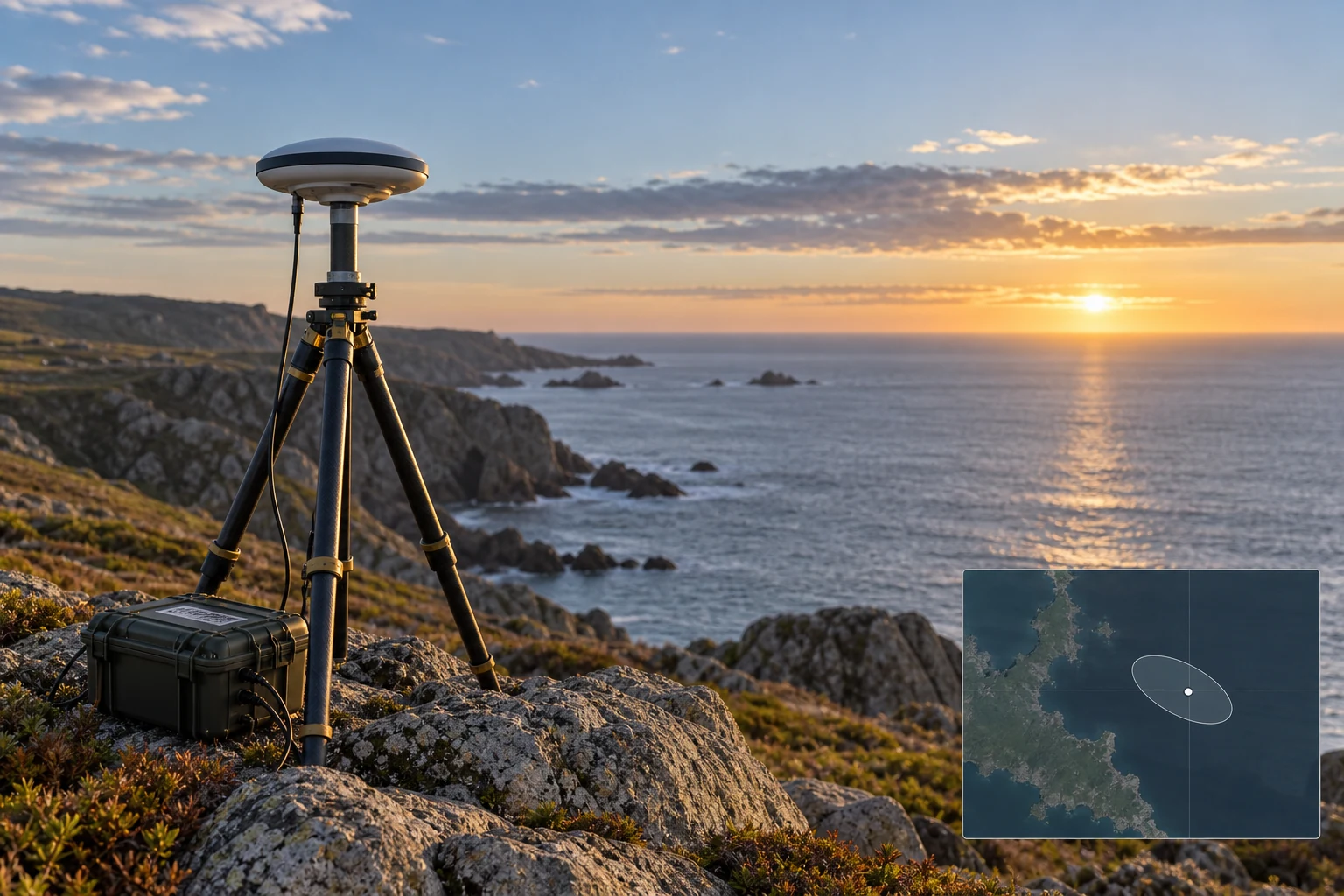
Backup PNT layers — celestial, X-ray pulsar, signals of opportunity, inertial — combine differently per mission profile. The barriers to operational use are detector size, weight, and integration time, not signal availability.
The vocabulary matters because policy hangs on it. Executive Order 13905 and the subsequent DHS Resilient PNT Conformance Framework define the public expectation that critical systems detect and respond to PNT degradation; the DOT Office of the Assistant Secretary for Research and Technology has published companion guidance for terrestrial systems. NIST SP 800-82 covers PNT integration into industrial control systems; the IEEE 1588 PTP and IEEE 1952 Resilient PNT working groups continue to produce standards-track outputs. For LEO assets, Space Force Strategic Plans and SpaceWERX BAA language explicitly call out PNT resilience as a priority.
The published threat taxonomy distinguishes degradation (signal weak), jamming (signal overwhelmed by RF noise in band), spoofing (false signals that mimic the real ones to redirect a receiver), meaconing (capture-and-replay), and natural disruption (ionospheric scintillation, solar storms). Each has different countermeasures, and a credible resilience claim must say which threats it addresses. Generic "GNSS-resilient" language without that taxonomy is a weak signal in any proposal.
Celestial navigation: the oldest backup
Celestial navigation predates GNSS by millennia and remains a viable backup for spacecraft. The published spacecraft-celestial-navigation literature treats star trackers as the primary sensor, with planetary horizon scanners and sun sensors as supporting modalities. Modern star trackers achieve arcsecond-class attitude accuracy and meter-class position accuracy when fused with onboard ephemeris. The trade-offs are well documented: thermal stability, radiation effects on CMOS imagers, and the computational cost of star-pattern matching at high update rates.
The published star-tracker engineering literature has converged on a few canonical algorithms. The Pyramid algorithm (Mortari and colleagues), the Search-Less Algorithm, and the Lost-in-Space identification methods handle pattern matching from arbitrary attitude. The QUEST and TRIAD attitude-determination algorithms (Shuster, Wahba, Markley) handle the attitude-from-vector-observations step. Open-source implementations exist in the Basilisk astrodynamics framework and several university toolboxes. Star catalogs from Hipparcos and Gaia anchor the public reference data.
Position determination from celestial observations alone — distinct from attitude determination — is harder and depends on the observation geometry. Stellar aberration provides a velocity signal; lunar and planetary ephemeris triangulation provides absolute position fixes. Recent work (Christian and others at NASA Goddard, Karpenko at Auburn) has demonstrated that lunar-limb-based optical navigation can deliver tens-of-kilometers position accuracy autonomously, which is a credible backup for several mission profiles.
X-ray pulsar navigation
NASA's SEXTANT experiment, conducted with the NICER instrument on the International Space Station in 2017–2018, was the first real-time autonomous X-ray pulsar navigation demonstration in space. The publicly reported results show position accuracy under approximately ten kilometers using sequential observations of multiple millisecond pulsars over roughly two days, with single-pulsar (Crab) accuracy on the order of tens of kilometers; the original program goal was better than ten kilometers in the worst direction. X-ray pulsar navigation is interesting because the signal sources are astrophysical and cannot be denied at their origin, and because the methodology is fully published. The barriers to operational use are detector size, weight, and integration time, not signal availability.
The methodology is well-anchored. The pulse time-of-arrival (TOA) is measured against a model timing solution from a pulsar database (the ATNF Pulsar Catalog, the EPTA timing models, the published NICER ephemerides). Position is estimated from the TOA differences across multiple pulsars, with the spacecraft clock and ephemeris parameters as nuisance variables. Sheikh, Ray, and the Naval Research Laboratory team published the foundational engineering work in the early 2000s; the SEXTANT papers extend it with operational demonstration data. The published literature discusses both the millisecond-pulsar timing-noise floor and the photon-rate-limited integration windows.
The operational cost question is real. The NICER instrument is approximately the size of a washing machine and was hosted on the ISS, not a free-flyer. Smaller silicon-drift-detector and microchannel-plate-based instruments are in development; published trade studies estimate that a ten-kilogram-class instrument can deliver useful pulsar-navigation performance for outer-solar-system missions where alternative options are sparse. For LEO assets, the operational case is weaker because GNSS is usually available; pulsar navigation is more credible as a deep-space backup or a hard-denied-environment failsafe than as a primary LEO source.
Signals of opportunity
For terrestrial and near-earth applications, signals of opportunity — broadcast television, AM radio, cellular, Iridium, Starlink — have a substantial recent open literature. For LEO spacecraft specifically, the relevant signals of opportunity include broadcast satellite signals from non-PNT constellations, terrestrial RF that reaches orbital altitudes, and inter-satellite ranging. The methodological pattern is similar across signal sources: model the geometry, estimate the unknown clock and ephemeris parameters jointly, and bound the achievable accuracy. Recent academic work has shown sub-kilometer accuracy in favorable geometries.
The published literature has well-known anchors. Kassas and the ASPIN Laboratory at UC Irvine have published a substantial body of work on signals-of-opportunity navigation using LEO constellations, with measured performance against Iridium NEXT, Starlink, and Globalstar transmitters. Reid, Walter, and others at Stanford have published on Starlink-based PNT. Humphreys at UT Austin has published on receiver-autonomous spoofing detection and on opportunistic ranging. The methodological convergence is on Doppler-based positioning when ephemerides are uncertain, with carrier-phase tracking when the geometry permits.
For LEO assets specifically, the calculus differs. Cross-link ranging within a constellation — including the publicly described inter-satellite links on SDA Tranche 0 and Tranche 1 — produces high-quality range observations between fellow assets, which can substitute for or augment GNSS in jammed regimes. The Optical Inter-Satellite Link standards (CCSDS, SDA) define the data formats. The methodology is conventional; the engineering challenge is the on-orbit integration.
Inertial-only intervals
For short GNSS outages, high-grade inertial measurement units provide bounded drift over minutes-to-hours intervals depending on grade. The publicly published trend is toward MEMS IMUs improving steadily but not yet rivaling fiber-optic or ring-laser gyros for the longest holds. The research interest is in fusion: an IMU plus a periodic celestial fix, or an IMU plus signals of opportunity, can stretch the bounded-error interval substantially. The fusion algorithms are conventional Kalman variants with growing use of factor-graph approaches from robotics.
The grade taxonomy is publicly documented. Tactical-grade IMUs (gyro bias on the order of 1–10 deg/hr) are common in commercial UAS and ground vehicles. Navigation-grade (~0.01 deg/hr) and strategic-grade (~0.001 deg/hr) are reserved for higher-cost platforms. For LEO spacecraft, the published flight history skews toward navigation-grade fiber-optic gyros (Northrop Grumman LITEF, Honeywell, Safran/Sagem product families) with MEMS-based units appearing in CubeSat-class missions where SWaP dominates. Cold-atom interferometric gyros (the public DARPA AIM and broader cold-atom-PNT literature) promise improvement but are not flight-qualified at the time of writing.
The fusion methods worth naming are also public. The error-state Kalman filter (Trawny, Roumeliotis) is the workhorse for IMU-aided navigation. Factor-graph approaches (iSAM, GTSAM, the broader visual-inertial SLAM tradition from Leutenegger, Forster, and others) provide flexibility for irregular-cadence updates and outlier rejection. For spacecraft specifically, the modified Rodrigues parameter and quaternion-based attitude representations avoid the gimbal-lock and singularity issues that plague Euler-angle parameterizations.
Engineering trade-offs
For software-first small businesses, the addressable problem is rarely the sensor — it is the fusion software, the calibration tooling, the evaluation harness, and the integration with existing flight-software architectures. The published research is rich enough that an offeror who reads carefully can identify which fusion or calibration improvement would be most valuable to a specific mission profile. The wrong move is to claim a new sensor; the right move is to claim a measurable improvement in the use of existing sensors.
The "measurable improvement" bar is concrete. A claim like "our fusion software reduces position-error growth by N percent during simulated GNSS outages of duration T, on bus B, against baseline algorithm A" is testable. A claim like "we offer a resilient PNT solution" is not. The published mission-profile diversity — from narrow-mission imaging satellites that need station-keeping accuracy to broader-mission platforms that need rendezvous-grade relative navigation — gives offerors plenty of specific scenarios to anchor measurable claims against.
Public PNT-Resilience Anchors a Reader Should Know
EO 13905 / DHS Resilient PNT Conformance Framework. The U.S. policy and conformance baseline for resilient PNT.
NICER / SEXTANT papers. The flight-demonstrated reference for X-ray pulsar navigation.
ATNF Pulsar Catalog, Hipparcos / Gaia. Public reference catalogs for pulsar timing and stellar position.
CCSDS / SDA inter-satellite link standards. The interoperability documents for cross-link ranging and time transfer.
Why this work matters to us
Precision Federal is a software-only SBIR firm. The reason articles like this one exist on this site is simple: federal program offices fund teams whose principal investigators have demonstrated, in public, that they think carefully about the problems the program is trying to solve. We write to demonstrate that posture, not to telegraph any particular technical approach. If your office is exploring the problem class above and wants a partner who reads the literature, codes the prototypes, and ships under a Phase I or Direct-to-Phase-II SOW, we are listening.
Common questions on the public-record framing
How well does X-ray pulsar navigation actually work in space today?
NASA's SEXTANT/NICER experiment demonstrated under approximately ten kilometers using sequential observations of multiple millisecond pulsars over roughly two days; single-pulsar accuracy ran tens of kilometers. Detector size and integration time are the binding constraints.
What inertial grades are in DoD use, and at what trade-offs?
Tactical, navigation, and strategic grades are the three published tiers. Higher grades extend bounded-drift intervals at higher SWaP and cost; MEMS continues improving but does not reach the high end.
What does this article not cover?
Mission-specific inertial calibration parameters, specific spacecraft fusion architectures, or any Precision Federal approach.
Frequently asked questions
Continuing to perform a mission when GPS or other GNSS signals are degraded, jammed, spoofed, or unavailable. For LEO assets, the threat environment includes intentional interference and natural sources — solar activity, geomagnetic events, and terrestrial RF spillover.
Celestial navigation with star trackers as the primary sensor; X-ray pulsar navigation as demonstrated by NASA's SEXTANT experiment on NICER in 2017–2018; signals of opportunity from non-PNT constellations and inter-satellite ranging; and inertial measurement units fused with periodic celestial fixes or signals of opportunity.
The publicly reported results show position accuracy under approximately ten kilometers using sequential observations of multiple millisecond pulsars over roughly two days, with single-pulsar (Crab) accuracy on the order of tens of kilometers; the original program goal was better than ten kilometers in the worst direction.
Fusion software, calibration tooling, evaluation harness, and integration with existing flight-software architectures. The published research is rich enough that an offeror who reads carefully can identify which fusion or calibration improvement would be most valuable to a specific mission profile.