
What these two vehicles are
OASIS+ (One Acquisition Solution for Integrated Services Plus) is GSA's professional services Best-in-Class IDIQ, successor to the original OASIS. It covers a broad sweep of professional services across multiple domains. CIO-SP4 (Chief Information Officer - Solutions and Partners 4) is run by NITAAC (NIH Information Technology Acquisition and Assessment Center) and is an IT-specific Government-Wide Acquisition Contract (GWAC) concentrated heavily on HHS agency task order flow, though any federal agency can use it.
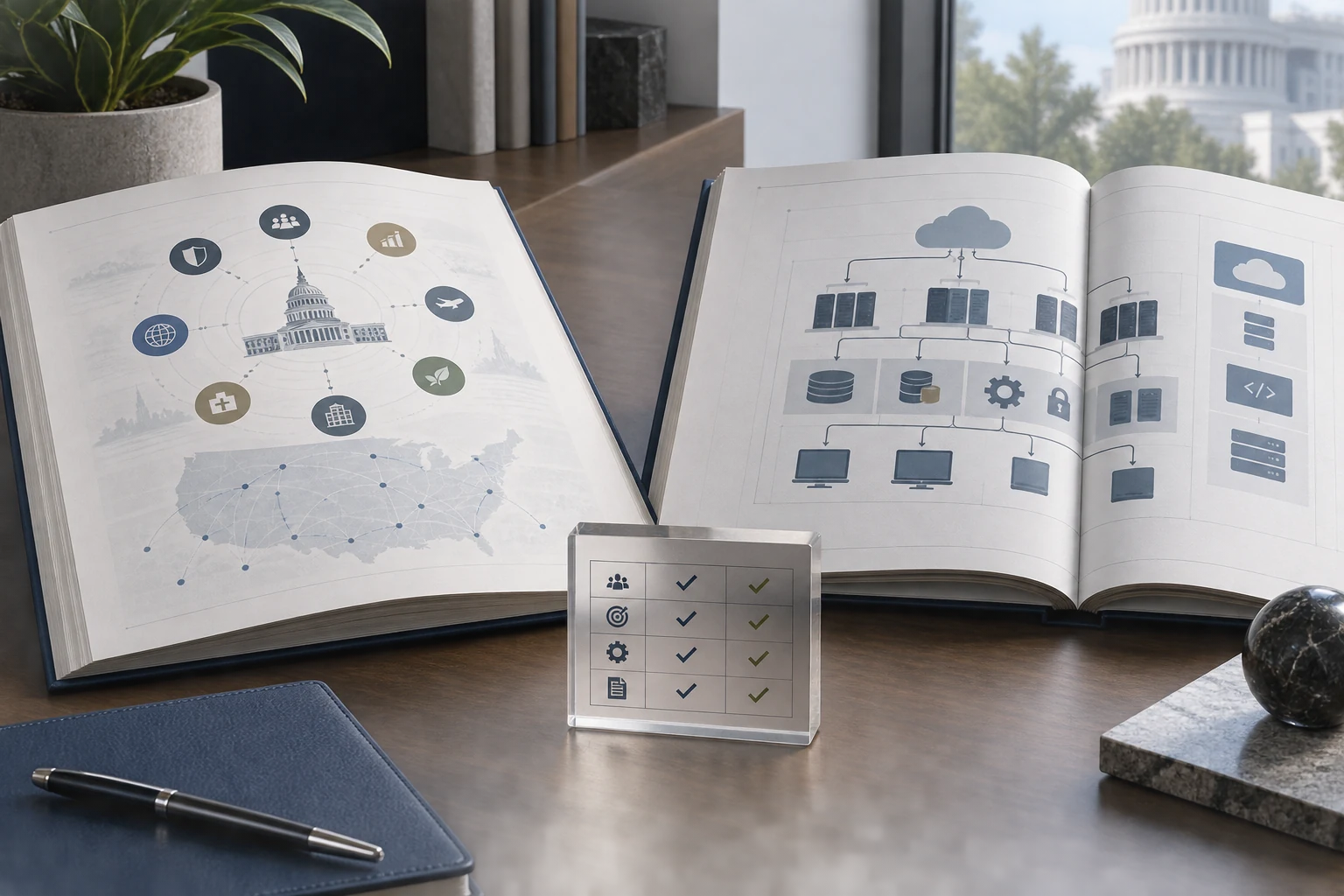
Both are prime contracts — meaning the firm holds a seat as prime and can bid task orders directly. Sub positions on other firms' primes are a separate matter. For a small AI firm deciding which to pursue as a prime, the question is really: which customer base fits, which pool gives you realistic access, and which has the task order velocity to justify the proposal cost.
Structural comparison
| Attribute | OASIS+ | CIO-SP4 |
|---|---|---|
| Administering agency | GSA | NITAAC (HHS / NIH) |
| Scope | Broad professional services across 7 domains (including Management & Advisory, Technical & Engineering, R&D) | IT services (10 task areas) — IT operations, cyber, software dev, digital services, AI/ML |
| Ceiling | No stated ceiling | $50 billion over 10 years |
| Period of performance | 10 years (5-year base + 5-year option) | 10 years (5-year base + 5-year option) |
| Pool / domain structure | 6 socioeconomic domains per each of 7 service domains (multiplicative pool structure) | 10 pools: Unrestricted, SB, 8(a), HUBZone, SDVOSB, WOSB — split by standard and health sub-areas |
| Small business access | Dedicated SB domain. 8(a), WOSB, HUBZone, SDVOSB all have their own domains and set-aside task orders. | Dedicated SB pool plus socioeconomic sub-pools. |
| Primary NAICS for AI | 541512 (Computer Systems Design), 541511, 541519, 541330 (Engineering Services). Domain and pool selection determines which NAICS governs. | 541512 (Computer Systems Design). |
| Access fee | No direct fee. Task order fee (CAF) embedded. | Task order fee approximately 0.65%. |
| Typical task order size | $500K — $50M+; some multi-hundred-million task orders. | $1M — $100M+; concentrated in HHS but used government-wide. |
| Bid frequency on task orders | High. Several hundred task orders per year across domains. | High. Hundreds of task orders per year, heavy HHS weight. |
NITAAC canceled the CIO-SP4 solicitation in early 2026 after years of protest cycles; workload rides on bridge arrangements while NITAAC decides its next move. The comparison below stands as a structural guide to how the two vehicle models differ — and the OASIS+ half remains fully current.
Which customers actually buy through each
OASIS+ task orders come from across the federal government. GSA's own agencies use it heavily. DoD components use it when they want a professional services vehicle that is not DoD-specific. State Department, Treasury, VA, DHS, and civilian agencies all place OASIS+ orders. The customer base is broad.
CIO-SP4 has a gravity center at HHS and NIH, the contract's home. CMS, NIH, FDA, CDC, and HRSA all drive significant task order volume. But CIO-SP4 is a GWAC — any federal agency can use it, and DoD, VA, DHS, and State routinely do. The tilt is HHS-flavored, not HHS-exclusive.
For an AI firm, this maps to: if your sales pipeline concentrates on HHS health AI, CMS claims processing, NIH data science, or FDA regulatory AI — CIO-SP4 is closer to your customer flow. If your pipeline is a broader mix of civilian and DoD professional services, OASIS+ is the better fit. Many mature firms hold both.
Small business access on each
Both vehicles have dedicated small business domains or pools, which is the reason a new firm can realistically compete at all. The pools segregate small business primes so a 10-person AI firm is not competing against Lockheed or Leidos for the same task order.
On OASIS+, a small business prime sits in the SB domain (or 8(a), HUBZone, WOSB, or SDVOSB if the firm qualifies). Task orders issued as small business set-asides are competed only within that pool. An 8(a) firm can bid both SB and 8(a) set-aside task orders. A firm with multiple socioeconomic designations can hold seats in multiple domains, each of which requires its own proposal and evaluation.
CIO-SP4's pool structure works similarly: the SB pool has its own awardees, the 8(a) pool has its own, and set-aside task orders flow to the relevant pool. An AI firm without 8(a), WOSB, HUBZone, or SDVOSB status competes in the unrestricted SB pool only.
How on-ramps work
Missing the initial award does not permanently lock a firm out. Both vehicles have on-ramp provisions, though timing differs. OASIS+ was designed with periodic on-ramps as a feature — GSA has stated an intent to open on-ramps during the 10-year performance period, with exact cadence TBD but historically every 2-4 years. CIO-SP4 has on-ramp authority but GSA/NITAAC timing has been less predictable. Each on-ramp is a full proposal cycle — not a shortcut — but it is a legitimate path for firms that were not ready on the initial competition.
What it costs to get on
The proposal cost for either vehicle is substantial. Proposal volume on OASIS+ or CIO-SP4 runs to several hundred pages across volumes, with heavy past performance and relevant project narratives. Typical time investment for a small firm:
- First-time OASIS+ proposal: 400-800 hours of internal effort plus $30K-$75K of proposal consulting if external help is engaged.
- First-time CIO-SP4 proposal: 300-600 hours plus $25K-$60K of consulting if external.
- Ongoing maintenance post-award: 80-120 hours per year for contract management plus task order bidding time.
The task order bidding effort is the ongoing cost. Winning a seat is the one-time expense. Bidding individual task orders is where the firm lives, year after year, for the contract life.
Task order competitive dynamics
Once on a vehicle, the firm competes against other awardees in its pool for task orders. The dynamics:
Most task orders are competed
, not directed. A Contracting Officer issues a task order RFP to all pool awardees and evaluates.
Pool size matters
A pool with 40 awardees is less competitive than a pool with 200. Check pool sizes before targeting the vehicle.
Incumbency at task-order level is real
Firms that have performed on the agency before — and especially on the specific program office before — win follow-on task orders disproportionately.
Directed task orders
(fair opportunity exceptions) happen but are the minority. Expect most work via competitive bid.
NAICS and size standard
Both vehicles use NAICS 541512 (Computer Systems Design Services) as a primary code for IT service work. The small business size standard at 541512 is $34 million in average receipts over three years. OASIS+ also uses 541511, 541519, and 541330 on certain domains, which can matter for a firm near the size ceiling — different NAICS carry different standards. A firm that is small under 541512 but large under a different code needs to be careful about which NAICS governs a given task order RFP.
Honest decision framework
A simple filter for a small AI firm deciding between the two:
- If your customer pipeline is dominated by HHS, NIH, CMS, FDA, CDC — CIO-SP4 would have been the natural first target before its 2026 cancellation; watch for NITAAC's successor vehicle.
- If your pipeline is broader federal civilian plus some DoD professional services — pursue OASIS+ first.
- If you have 8(a), HUBZone, WOSB, or SDVOSB status, lean toward the vehicle where that socioeconomic domain has more task orders for your scope — for most AI firms, that is OASIS+.
- If you are brand new with no past performance, neither is realistic for the initial award. Pursue SBIR and direct subcontracts first, then on-ramp when past performance is in hand.
- If you are mature enough to pursue both, start with one, win it, and add the other at the next on-ramp.
Where Precision Federal sits
The sequencing that makes sense for a firm at our stage: build award history through SBIR wins and direct awards through 2026-2027, then pursue the next available on-ramp on whichever vehicle matches the task order flow at that point. Bypassing this sequence — trying to win a seat on a major IDIQ without past performance — is a waste of proposal effort.
Bottom line
OASIS+ and CIO-SP4 are both legitimate long-term targets for an AI firm that wants prime position on a broadly-used government IDIQ. Neither is better on the merits; they match different customer profiles. Get past performance first. Pursue the vehicle your customer base actually orders from. Budget honestly for the proposal cost. Expect the payoff to be year three and later, not year one.
Frequently asked questions
Structurally, OASIS+ is broad professional services and CIO-SP4 was IT-specific with HHS gravity — but NITAAC's early-2026 cancellation of CIO-SP4 settles the near-term question: OASIS+ is the live target.
Yes, via dedicated small business pools. Task orders are set aside to the pool, so you are not competing against Leidos or Lockheed for the same work.
400-800 hours internal time plus $25K-$75K of proposal consulting for a first-time offer. Ongoing bid cost is where the real spend lives.
OASIS+ is designed with periodic on-ramps; a successor NITAAC vehicle would set its own. Each on-ramp is a full proposal cycle.
Primarily 541512 for both. OASIS+ uses additional NAICS on certain domains. Size standard at 541512 is $34M average receipts.
Billions per year flowed through each family. CIO-SP4 was planned with a $50B ceiling over 10 years before its cancellation. OASIS+ has no stated ceiling. Individual task orders range from six figures to hundreds of millions.