
Higher score = stronger discipline in published LLM-augmented ops research.
What "battle rhythm" actually means
Battle rhythm is the published doctrine term for the recurring sequence of meetings, products, and decision points that an operations center runs through every day. Morning update, intelligence briefing, planning sync, commander's update, mission rehearsal, after-action review — each tied to a specific time, audience, and decision. The rhythm exists because synchronization across many people who do not share an office requires structure.
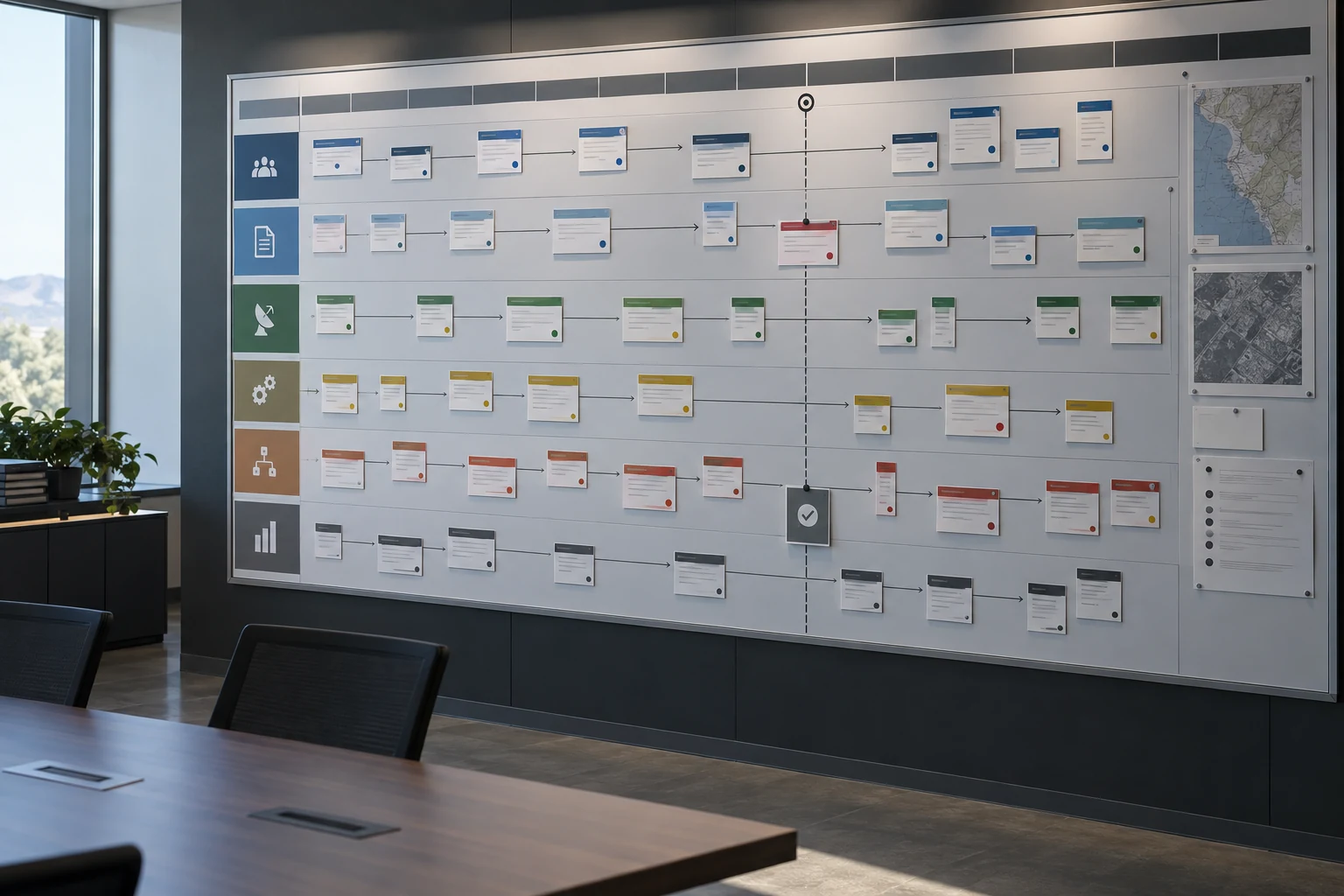
The public research on operations centers describes a few load problems with this structure. Information arrives faster than the rhythm metabolizes it. Meetings produce decisions that downstream meetings need to know about. Briefings get assembled by hand from inputs scattered across email, chat, and shared drives. Personnel rotate, so institutional memory of "why we do it this way" decays. And the chief watching it all is supposed to spot when the rhythm itself is breaking.
LLMs are interesting here not because they can replace any of this, but because they can compress, route, and surface the flow without taking the human out of the decision loop.
Why decompose into modules instead of one monolithic system
The temptation with LLMs is to build one big system that does everything. The published research is consistent that this fails — for evaluation reasons, not just engineering reasons.
Operations centers do many distinct things: tracking taskings, managing the meeting calendar, summarizing intel feeds, drafting briefings, monitoring resource conflicts, capturing decisions, generating after-action reports. A single model trying to do all of them at once is impossible to evaluate — if the system is wrong about a tasking status, you cannot tell whether the model misread the input, miscompressed the context, or misformatted the output.
The published architectures decompose by function. A meeting-summary module, a tasking-tracker module, a brief-generation module, a conflict-detection module — each runs against a narrow input and emits a narrow output that the next module can consume. Each module is independently evaluable, independently versioned, and independently turn-off-able when it misbehaves.
This is the same lesson commercial teams learned about agentic systems. Compound, narrow modules with clean interfaces beat single big models. The ops domain just makes the lesson more visible because the consequences of a wrong output are more legible to a chief watching the rhythm.
Workload metrics with names
You cannot manage a rhythm that is breaking if you do not have words for what is breaking. The published research on cognitive-workload measurement in ops centers names the load patterns explicitly so they can be tracked.
One named pattern is what some published work calls a Conflict Complexity Index (a workload-quantification metric with roots in the cognitive-task-modeling literature) — a score that goes up as the number of overlapping taskings, contested resources, and decision dependencies grows. Another is Decision Latency — how long it takes a question raised in one meeting to actually get answered. Another is Information Half-Life — how quickly a briefing's facts go stale relative to the next briefing's expectations.
None of these are universally standardized; the specific metric names vary across services and across research groups. The pattern that survives review is having named metrics at all — concrete numbers a chief can watch — rather than relying on anecdotal sense of "this rhythm feels heavy today."
An LLM-augmented system can compute these metrics passively, by reading the inputs the rhythm already produces (chat threads, calendar, tasker tracker) and emitting a dashboard the chief sees. The model is not making the decisions. It is surfacing the load patterns the chief is already trying to read.
| Module | What it does | What it consumes | What it emits |
|---|---|---|---|
| Meeting summarizer | Compresses meeting transcripts into structured notes | Transcript, attendee list, prior notes | Decisions, action items, open questions |
| Tasking tracker | Maintains state of every open tasking | Meeting summaries, chat, email | Task graph with status, dependencies, owners |
| Brief generator | Drafts the next scheduled briefing | Tasking tracker, intel feed, prior briefs | Draft briefing with citations to source events |
| Conflict detector | Flags resource and timeline conflicts | Calendar, task graph, resource roster | Conflict alerts ranked by complexity score |
| Workload dashboard | Computes named cognitive-load metrics | All of the above | Time-series metrics for the chief |
Graph analysis of the operations network
Most of what an ops center does can be modeled as a graph — nodes for taskings, decisions, people, and resources; edges for dependencies, owners, and conflicts.
Graph analysis is well-studied territory in operations research, and the published methods (centrality measures, community detection, critical-path analysis) apply directly to the rhythm. Centrality scores reveal which taskings are bottlenecks because too many other taskings depend on them. Community detection reveals informal teams that have coalesced around shared work that the formal org chart does not reflect. Critical-path analysis reveals which sequences of taskings are on the longest dependency chain — the ones that, if they slip, cause the rhythm itself to slip.
An LLM contributes here by extracting the graph from unstructured inputs. Meeting transcripts, chat threads, and email do not arrive as nodes and edges; they arrive as text. The model extracts entities (taskings, people, resources), classifies relationships (depends-on, owned-by, contested-with), and emits the graph for the analysis tools to consume.
This is a pattern the public research consistently calls structured extraction. The LLM is doing what it is good at — reading messy text and producing structured records — and handing off to graph-analysis tools that have their own decades of methodology.
Briefing generation that an O-6 will sign
Draft briefings are the most visible LLM output in an ops center. They are also the highest-stakes output, because a chief is going to put their name on the final version.
The published research on briefing generation — in operations, intelligence, and clinical contexts — converges on a few non-negotiables. Every claim cites the source event. The draft is structured to match the briefing's expected sections, not freeform prose. Confidence is reported per claim, with low-confidence items flagged for the chief's attention before delivery. The draft is editable, not a take-it-or-leave-it artifact — the workflow assumes the chief will rewrite parts of it, and the system tracks the deltas.
The failure mode that haunts this domain is hallucinated facts. A draft that confidently asserts something the source events do not support, slipped past a tired chief at a 0500 update, is a failure that ends adoption. The published research on faithfulness evaluation (RAGAS, TruLens, atomic-claim verification) is directly relevant, applied to the briefing draft before the chief sees it.
Instructor-in-the-loop control
The published research from training and exercise contexts — where instructors observe students running an ops center under load — emphasizes a specific pattern: the instructor (or chief, in real ops) needs the ability to intervene at any layer of the system, with low friction.
That means the instructor can override a module's output. The instructor can pause a module that is misbehaving without paying down the whole stack. The instructor can adjust thresholds (what counts as a conflict, what triggers an alert) live. And the instructor's interventions are logged so the post-exercise debrief can reconstruct what the system did and what the human changed.
This is not about distrust of the system. It is about preserving the chain of authority. In an ops center, decisions are made by people with authority to make them. An LLM-augmented system that takes any decision out of that chain is failing the doctrine. The published research that survives review treats the system as decision-support and treats the instructor's override as the most-important interface.
Evaluation that survives an after-action review
Standard NLP benchmarks do not capture whether an LLM-augmented ops system is actually helping. The published evaluation methodology is more like clinical trials than like ML benchmarks.
Realistic exercises with control and treatment conditions. Cognitive-load measurements (subjective NASA-TLX scales, behavioral measures, occasionally physiological measures) compared across conditions. Decision-quality assessments by independent reviewers blinded to which condition produced which decisions. Time-to-decision measurements on standardized scenarios. Adoption proxies — do operators use the system when they are not required to?
None of this is cheap. The published work that does it well is small-N (a few dozen participants, a few exercises) and reports effect sizes with appropriate uncertainty. The methodology that survives an after-action review is honest about the limits of the evaluation, names what was not tested, and resists the temptation to over-claim from a small sample.
Common questions on the public-research framing
Why not build one big model that runs the whole ops center?
Because you cannot evaluate it. When the system is wrong about a tasking status, a single big model gives you no way to tell whether the failure was input understanding, context compression, or output formatting. Decomposed modules each evaluate independently and can be turned off when they misbehave.
What is the most-important interface in this kind of system?
The override. The chief or instructor needs to intervene at any layer, with low friction, and have those interventions logged. Doctrine puts decisions with the people who have authority to make them, and an LLM-augmented system that takes decisions out of that chain is failing the doctrine.
What does this article not cover?
Specific service ops centers, specific named systems, or any Precision Federal architectural approach to a particular ops problem.
Frequently asked questions
The recurring daily sequence of meetings, products, and decision points an operations center runs through — morning updates, planning syncs, commander's updates, after-action reviews. The rhythm exists because synchronizing many people across many staff sections requires structure. Public Joint and Service doctrine describes this in detail.
Information arrives faster than the rhythm metabolizes it. An LLM compresses meeting transcripts into decisions and action items, drafts briefings from scattered inputs, and surfaces workload patterns to the chief — without taking decisions out of the human chain of authority. It is decision-support, not decision-making.
Concrete numbers a chief can watch: how many overlapping taskings exist (a complexity index), how long it takes a question raised in one meeting to get answered (decision latency), how stale a briefing's facts are relative to the next briefing's expectations (information half-life). Specific names vary across services; the pattern that survives review is having named metrics at all.
More like clinical trials than ML benchmarks — realistic exercises with control and treatment conditions, cognitive-load measurements, decision-quality assessments by blinded reviewers, time-to-decision on standardized scenarios, and adoption proxies. The methodology that survives review is small-N, honest about limits, and resists over-claiming from small samples.
How we use this site
We write articles like this to make our reading of the open literature visible — what we think the published methods say, what the open gaps are, and where careful work might land. We do not use these pages to preview proposed approaches in active program spaces. Precision Federal is a software-only SBIR firm. If your office is funding work in this area and would value a software-first partner with a documented public-reading habit, we welcome the introduction.