
Editorial weighting from public sources and practitioner reading — illustrative, not a measured statistic.
Higher score = the dimension is more thoroughly addressed in the public literature.
The program in plain language
DARPA's ASEMA program — Assessing Security of Encrypted Messaging Applications — addresses the security of encrypted messaging applications used on mobile platforms. The premise of the publicly available solicitation is that secure messaging is now load-bearing infrastructure for both civil society and defense communications, and that the gap between cryptographic-protocol guarantees on paper and the security delivered by a real running app on a real phone has not been closed by existing tooling.
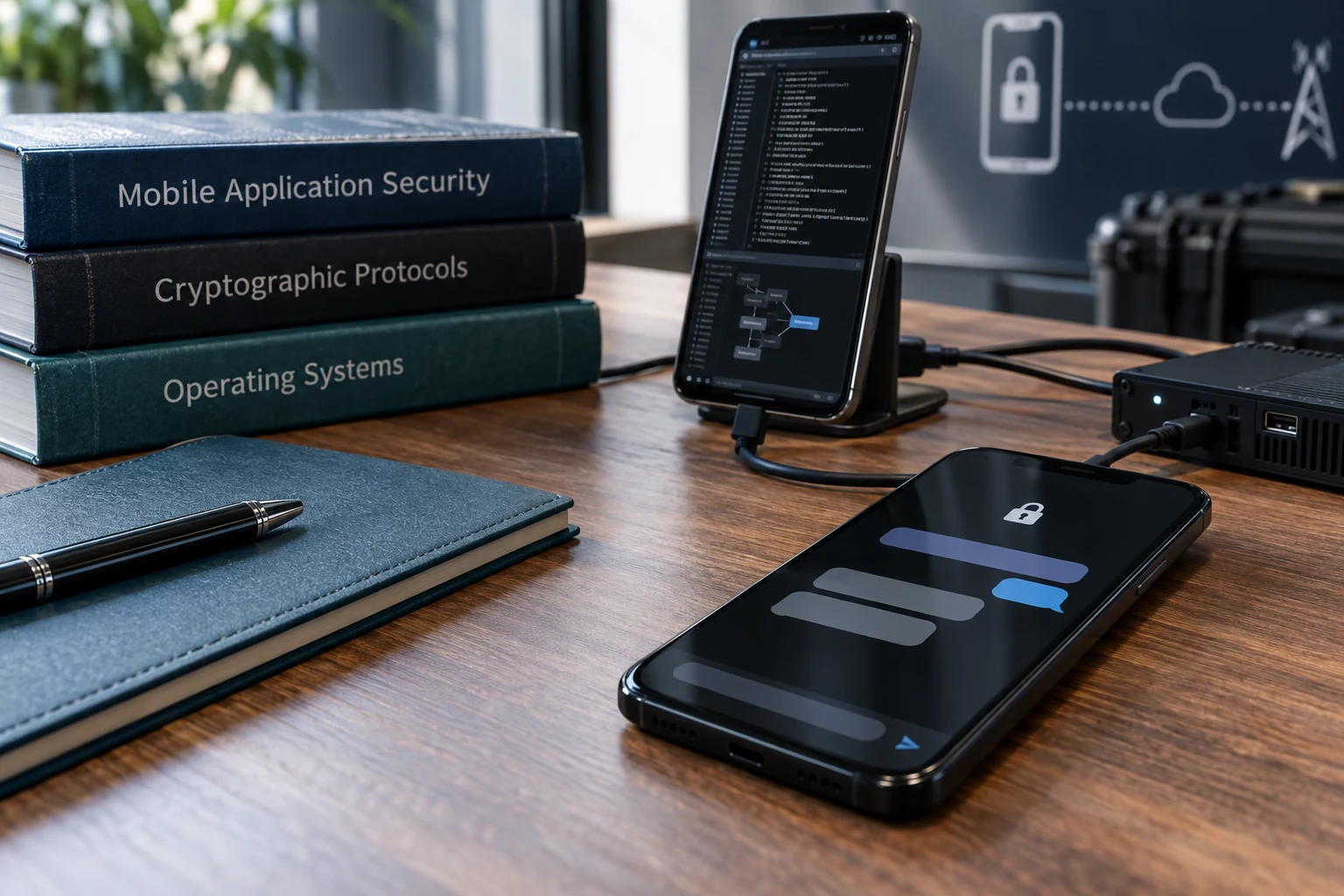
Cryptographic protocols are well-analyzed (Tamarin, ProVerif, F*). Application-layer code that surrounds the protocol is where most published vulnerabilities surface. The methodological frontier is bridging protocol-level guarantees to implementation-level evidence.
The structural argument the program makes is one the open security community has been making for a decade. Encrypted messengers used at scale — Signal, WhatsApp, iMessage, Wickr, Wire, Threema, Element, Session, and others — sit on top of formally analyzed cryptographic protocols, but the security guarantees the user receives depend on the entire stack: the protocol implementation, the cryptographic library it links against, the application code around it, the mobile-OS primitives it relies on, and the human factors of the user interface. Each layer has independent failure modes and largely independent literatures.
The program's contribution, then, is less about producing new cryptographic primitives and more about producing tooling that compresses the cost of doing real security assessments across that full stack. That framing — workflow improvement rather than primitive invention — is consistent with DARPA's other recent application-security programs (e.g., HACMS, CASE, ARCOS) and signals what an offeror should expect to be evaluated against.
What the cryptographic-protocol community has done
The Signal Protocol — the double-ratchet construction that underpins the Signal app, WhatsApp, Facebook Messenger's secret conversations, and several other messengers — has been the subject of substantial open formal-verification work. Cohn-Gordon, Cremers, Dowling, Garratt, and Stebila published the first comprehensive cryptographic analysis of the Signal Protocol in 2017, and ProVerif and Tamarin Prover analyses of variants have followed. Group-messaging extensions — most prominently the IETF's Messaging Layer Security (MLS, RFC 9420) — have been verified at the protocol layer by separate academic teams. The protocol-level guarantees are well understood. The application-level guarantees are not.
The toolchain the protocol-verification community uses is itself worth naming. Tamarin and ProVerif are the two dominant symbolic protocol verifiers, with EasyCrypt providing a complementary computational-soundness path. CryptoVerif sits in between. F* and Coq have been used for end-to-end verified TLS implementations (Project Everest's miTLS / HACL*). For mobile-application context specifically, the published verification work tends to verify protocol fragments against assumed-correct cryptographic libraries; the libraries themselves — libsodium, BoringSSL, OpenSSL, Apple's CoreCrypto — receive separate scrutiny under different programs and audit regimes.
The post-quantum dimension is increasingly part of this work. NIST's PQC standardization (FIPS 203 ML-KEM, FIPS 204 ML-DSA, FIPS 205 SLH-DSA) anchors the migration path; the Signal team's PQXDH key-exchange combiner is one of the first deployed hybrid post-quantum constructions in a major messenger. Open verification of PQXDH and related hybrid constructions is in progress in the academic literature, and the assessment toolchain will need to handle both classical and post-quantum modes through the transition.
The gap between protocol and implementation
Protocol verification establishes that, given a faithful implementation of the protocol over a faithful cryptographic library, certain confidentiality and authentication properties hold. None of those qualifiers is automatic. Public security research has repeatedly documented that the most consequential vulnerabilities in encrypted messengers reach users through implementation paths rather than cryptographic ones. The pattern in the published advisories is consistent — cryptography is rarely the failure point; surrounding application logic usually is.
The well-known public examples illustrate the point. The 2019 Signal "FaceTime-style" call-acceptance bug stemmed from session-state handling, not double-ratchet math. The 2017 WhatsApp group-membership concern documented by Rösler, Mainka, and Schwenk identified that group-add semantics — application-layer logic — could undermine end-to-end guarantees that the cryptographic protocol provides only between sender and intended recipient. Multiple media-handling, link-preview, and parser bugs across messengers have produced remote-code-execution paths through the rendering stack, well clear of any cryptographic primitive.
The methodology that addresses the gap, in the open literature, is a mix of static analysis, dynamic instrumentation, fuzzing of structured inputs, and protocol conformance testing of real binaries. Frida, objection, and the broader mobile dynamic-analysis ecosystem are well-published. AFL++, libFuzzer, and structure-aware fuzzers like Nautilus and Grammarinator handle the parser surface. The open question — and the program's premise — is how to integrate these techniques into a workflow whose output is a defensible, reproducible assessment of a specific deployed messenger version.
Public reference methods
- Protocol verification — Tamarin Prover, ProVerif, F* — formal cryptographic protocol analysis.
- Static analysis & fuzzing — Semgrep, CodeQL, libFuzzer, Jazzer for implementation-layer review.
- Mobile instrumentation — Frida, QBDI, Corellium for runtime and platform analysis.
- Standards reference — OWASP MASVS / MASTG, IETF MLS RFC 9420, NIST FIPS 203-205.
- Reporting discipline — CVE/CWE/CVSS, vendor advisories, reproducible PoCs.
Mobile-OS attack surface
An encrypted messenger does not run in a vacuum. It runs as one app on Android or iOS, sharing process and storage primitives with the rest of the device. The published mobile-security literature documents that several distinct attack-surface classes affect secure messengers — beyond the protocol itself — and that each has its own peer-reviewed evidence base. None is solved by improving the protocol.
The taxonomy worth naming explicitly: the IPC and intent-handling surface (Android intents, iOS URL schemes, ContentProviders, share extensions); the on-device storage surface (SQLite databases, file-system encryption, keystore primitives like Android Keystore and iOS Keychain, Secure Enclave integration); the rendering and parsing surface (HTML/JavaScript-rendering WebViews, image and video decoders, link-preview fetchers); the notification and lock-screen surface (what message content is exposed before authentication); and the backup and cloud-sync surface (iCloud Backup behavior, Google One backups, restore flows that re-key conversations). Each has produced multiple published advisories per year for the past decade.
Each surface also has its own evaluation tooling. MobSF, drozer, and QARK target Android intent and component surfaces. iVerify, Frida-iOS-Dump, and Theos provide iOS-side instrumentation. Manticore, Ghidra, and Binary Ninja with relevant plugins handle the static-analysis surface. The published mobile-security curriculum at OWASP MASVS / MASTG codifies the assessment expectations across the surfaces. An assessment toolchain that integrates these into a reproducible workflow is what the program is positioned to advance.
Metadata privacy
End-to-end encryption protects message content, not the fact that two endpoints are communicating. Open research on metadata-private messaging — Vuvuzela, Loopix, Pung, the family of mixnet-style designs — has produced credible academic results, but none has displaced the dominant deployed pattern of "encrypt the content, accept the metadata leakage." For a defense-relevant assessment, metadata properties are often as important as content properties; the published research community has been candid about how far current deployments are from acceptable.
The dimensions of metadata that the published literature treats are concrete. Sender and recipient identifiers. Group memberships. Timing of message exchanges. Sizes of ciphertexts (which leak information about plaintext length). IP addresses of endpoints and the network paths between them. Server-side rate-limiting fingerprints. Each can be observed without breaking any cryptographic primitive. Sealed Sender (Signal) and contact-discovery innovations using Intel SGX or AMD SEV-SNP attestation have moved the deployed bar, but the published community is clear that these are mitigations, not full metadata privacy.
Side channels and platform integrity
Side-channel research on encrypted messaging has covered timing, power, electromagnetic, and acoustic channels at the device level, plus network-traffic analysis at the link level. The published evidence base is uneven — well-developed for some attack classes, thin for others. Platform-integrity questions — whether the app binary on the device is the binary the developer signed, whether the OS underneath has been compromised by a high-end attacker, whether secure-enclave attestation is reachable — interact with the messaging assessment in ways the program has explicitly acknowledged. Reading the public solicitation carefully shows a recognition that an app cannot be more secure than the platform it runs on.
The traffic-analysis literature in particular has matured. Published work on website fingerprinting (the cumulative WeFDE-style work from Wang, Goldberg, and others), on Tor traffic analysis, and on metadata-only inference of messaging-app behavior has shown that an attacker with passive network observation can extract surprising amounts of structure from encrypted flows. Padding schemes, traffic-shaping countermeasures, and constant-rate cover traffic are the published mitigations; each carries its own bandwidth and battery cost on a mobile device.
The platform-integrity question connects to a broader open conversation about hardware roots of trust — Apple's Secure Enclave Processor, Android's StrongBox and Trusty TEE, ARM TrustZone — and to remote-attestation standards like the IETF RATS architecture. A messaging-assessment toolchain that respects what these primitives can and cannot guarantee is more credible than one that treats every platform identically.
Methodology that survives review
The published methodology for assessing real messengers has converged on multi-technique coverage paired with reproducible reporting. The open community has been clear that no single technique suffices, and that the reporting discipline (write-ups, advisories, CVEs) is what turns research into something agencies can act on.
The reporting discipline has formal anchors. The CVE Numbering Authority program and MITRE's CWE taxonomy are the public infrastructure; CVSS v4 is the public severity scoring. Reports that produce CVE-grade findings, with reproducer artifacts, threat models, and CWE classifications, are immediately usable by the broader community. Reports that stop at "we found an issue" are not. The ASEMA framing — workflow improvements that produce defensible assessments — implicitly endorses the CVE-grade reporting bar.
What ASEMA is asking for, in public terms
The publicly available solicitation language asks for technology that meaningfully reduces the cost and time of producing trustworthy security assessments of encrypted messaging applications. That framing matches the gap the open literature has identified: mature individual techniques, immature integration. SBIR offerors who can point to demonstrable improvements in the workflow are positioned for serious consideration.
The "demonstrable improvement" bar is concrete: a published reduction in analyst-hours per assessment, a measured increase in coverage of a defined attack-surface taxonomy, a reproducible artifact that another team can run on another messenger and get comparable findings. Vague claims about "AI-augmented assessment" or "next-generation analysis" without an articulated workflow improvement are presumptively weak. The strongest offerors will quantify what they improve, against what baseline, on what assessment task.
Public Methodology Anchors a Reader Should Know
Tamarin Prover and ProVerif. The two dominant symbolic protocol verifiers; baseline tooling for any cryptographic-protocol claim.
OWASP MASVS / MASTG. The community-codified mobile-app security verification standard and testing guide.
IETF MLS (RFC 9420) and PQXDH. The two recent protocol developments most relevant to deployed messengers.
NIST FIPS 203/204/205 and SP 800-227. The post-quantum standards and the published guidance for migrating cryptographic systems.
Why this work matters to us
Precision Federal is a software-only SBIR firm. Articles like this one exist on this site because federal program offices fund teams whose principal investigators have demonstrated, in public, that they read the relevant literature and think carefully about the problem before writing a proposal. We write to demonstrate that posture, not to telegraph any technical approach. If your office is exploring the encrypted-messaging-security problem class and wants a partner who reads the published work, codes the prototypes, and ships under a Phase I or Direct-to-Phase-II SOW, we are listening.
Common questions on the public-record framing
What public reference frameworks anchor encrypted-messaging analysis?
OWASP MASVS and MASTG for app-layer assessment; NIST FIPS 203-205 for post-quantum cryptography; IETF RFC 9420 for Messaging Layer Security. Each is well-cited.
Where does protocol verification stop and implementation analysis begin?
Protocol analysis (Tamarin, ProVerif, F*) establishes mathematical guarantees. Implementation analysis confirms whether the deployed code honors those guarantees. Both are needed.
What public CVE corpus is most informative for messaging-app review?
NVD and vendor-specific advisories. The pattern is that cryptographic protocols are rarely the failure point; surrounding application logic usually is.
What does this article not cover?
Specific vulnerabilities under embargo, specific app internals beyond what is published, and any Precision Federal solution approach.
Defense Advanced Research Projects Agency
DARPA's Information Innovation Office (I2O) has a long lineage of encryption- and program-analysis-adjacent investments — HACMS, CASE, ARCOS, AIxCC. Each program publishes openly on methodology and results. The recurring program-design pattern is rapid prototyping with a defined transition gate, which shapes how solicitations are structured and how proposers are expected to demonstrate progress.
Frequently asked questions
ASEMA — Assessing Security of Encrypted Messaging Applications — is a DARPA program that addresses the security of encrypted messaging applications used on mobile platforms. The premise of the public solicitation is that the gap between cryptographic-protocol guarantees on paper and the security delivered by a real running app on a real phone has not been closed by existing tooling.
Substantial open formal-verification work on the Signal Protocol — including the 2017 Cohn-Gordon, Cremers, Dowling, Garratt, Stebila analysis and subsequent ProVerif and Tamarin work — and protocol-layer verification of group-messaging extensions including IETF MLS (RFC 9420). Protocol-level guarantees are well understood; application-level guarantees are not.
End-to-end encryption protects message content but not the fact that two endpoints are communicating. Open research on metadata-private messaging — including Vuvuzela, Loopix, Pung, and other mixnet-style designs — has produced credible academic results, but none has displaced the dominant pattern of accepting metadata leakage in deployed apps.
Multi-technique coverage paired with reproducible reporting. No single technique suffices, and the reporting discipline — write-ups, advisories, CVEs — is what turns research into something agencies can act on.