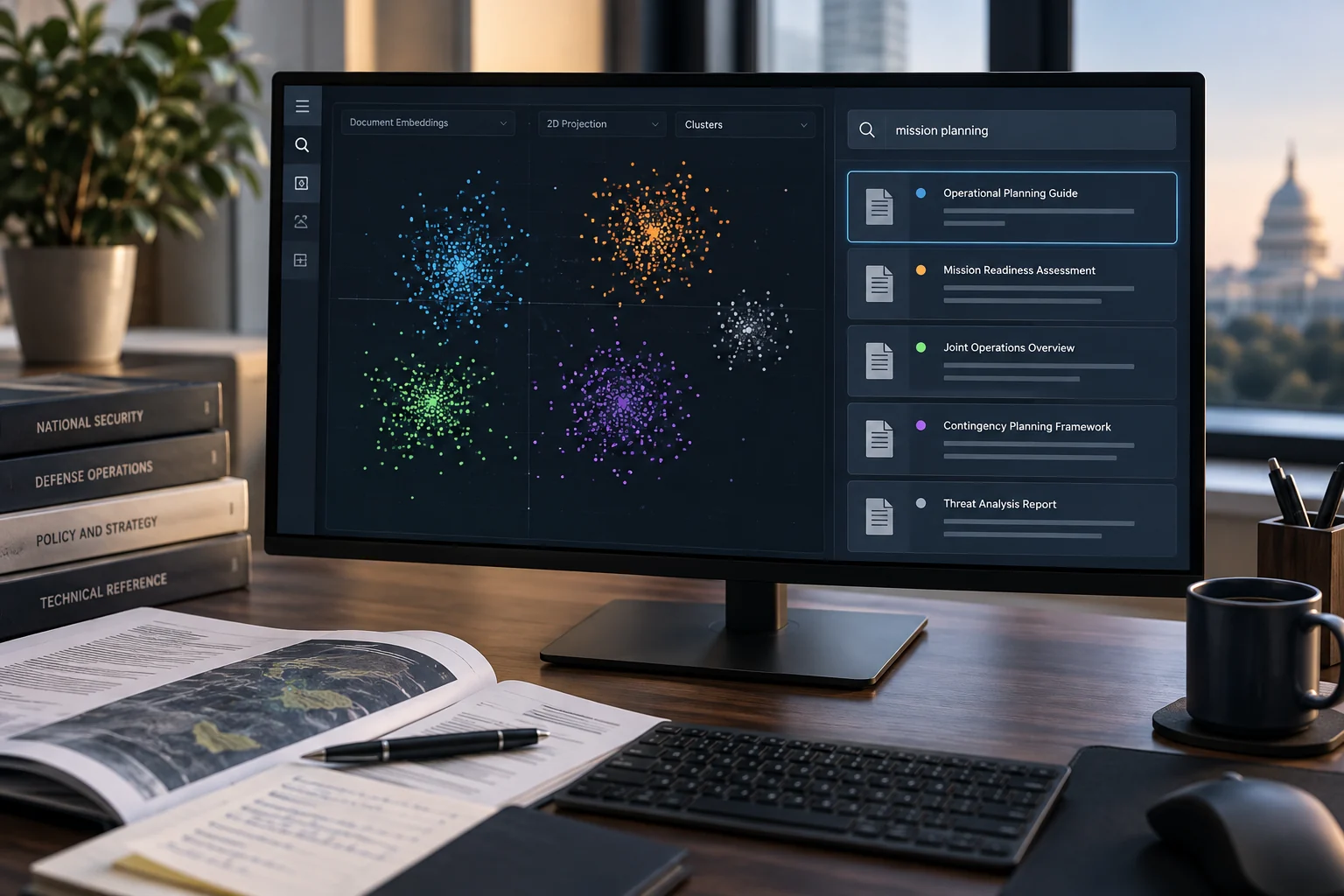
Overview — why federal vector search is different
Vector databases hit mainstream right as generative AI did, and the federal government has been scrambling to catch up ever since. But "install Pinecone and point a chatbot at it" is not a federal answer. Federal vector systems must respect data boundaries (CUI, ITAR, IL4/IL5), must be auditable (who retrieved what, when, why), must not memorize and leak PII, and must run inside FedRAMP-authorized perimeters. The correct first question is almost never "which vector DB?" — it is "what corpus, what retrieval quality metric, what boundary, what LLM, what user workflow?"
Precision Federal builds federal vector search and retrieval systems from first principles. We are a SAM.gov registered small business (UEI Y2JVCZXT9HP5, CAGE 1AYQ0, NAICS 541512) with hands-on experience building retrieval pipelines that actually meet agency quality thresholds — not demo notebooks that fall apart on real data.
Our technical stack

| Layer | Primary | Alternates | When we use it |
|---|---|---|---|
| Vector store (default) | pgvector on Aurora PostgreSQL | OpenSearch k-NN, Milvus, Weaviate | Up to ~10-50M vectors, GovCloud-native. |
| Vector store (scale) | Milvus on EKS | Qdrant, Vespa | 100M+ vectors, horizontal scale. |
| Vector store (hybrid) | OpenSearch with k-NN | Elasticsearch dense_vector | When lexical + vector in one index. |
| Managed / SaaS | Pinecone FedRAMP | Weaviate Cloud Gov | Rarely — boundary-dependent. |
| Embedding models | BGE, E5, Nomic Embed | Cohere Embed, OpenAI text-embedding-3 | Open source default; commercial when eval justifies. |
| Reranker | BGE reranker-large | Cohere Rerank, ColBERTv2 | Second-stage ranking for precision. |
| ANN algorithm | HNSW | IVF_PQ, DiskANN, ScaNN | HNSW by default; IVF_PQ for memory-limited. |
| Chunking | Structure-aware (Markdown, PDF) | Fixed-size, semantic chunking | Respect document semantics. |
| Orchestration | LlamaIndex, LangGraph | Haystack, custom | LlamaIndex for retrieval; LangGraph for agents. |
| Eval | Ragas + custom judge LLM | TruLens, DeepEval, Promptfoo | Across the stack + retrieval-specific metrics. |
Federal use cases
Regulatory document retrieval
e.g., CFR, NIST publications, agency policy libraries.
Legal e-discovery assistants
for DOJ, agency OGCs, and GAO.
Veteran benefits Q&A
VA-wide benefits encyclopedia retrieval. VA page.
Medicare / Medicaid policy retrieval
CMS manual navigation for provider support. HHS page.
Procurement intelligence
semantic search across FPDS, SAM, and past-performance corpora.
Investigative discovery
semantic search across acquired document collections for the FBI and IGs. FBI page.
Technical manual retrieval for maintenance
Army and Navy maintenance manuals surfaced by task. Army page.
Grants writing assistance
NIH and NSF grant officers retrieving precedent awards.
Immigration case support
adjudicator assistance for USCIS. DHS page.
Congressional correspondence
retrieval-assisted response drafting for agency legislative affairs.
Reference architectures
1. pgvector-backed RAG in GovCloud
Documents stored in S3. A chunking and embedding worker (Step Functions + Lambda) processes new uploads, writes chunk text + embedding vector to Aurora PostgreSQL with pgvector. Retrieval service (FastAPI) hits Aurora with a hybrid query — pgvector cosine similarity plus BM25 through a tsvector index — and reranks the top 50 with a local BGE reranker hosted on an ECS GPU task. Generation via Bedrock Claude over an agency-approved endpoint. Audit logs capture (user, query, retrieved chunks, generation, feedback). Everything inherits the FedRAMP High baseline of Aurora + Bedrock.
2. Milvus on EKS for enterprise-scale semantic search
100M+ document chunks across an agency-wide corpus. Milvus cluster on EKS (16 query nodes, 8 data nodes, MinIO for object storage). HNSW indices. Ingest via Kafka from source systems. An OpenSearch sidecar holds BM25 for hybrid. Retrieval hits both stores in parallel and fuses with RRF. GPU rerank via Triton Inference Server.
3. Classified-adjacent on-prem retrieval
For agencies with on-prem retrieval requirements, Milvus on bare-metal Kubernetes with local NVMe; embeddings generated via a locally hosted model server (vLLM + open BGE model). Zero external dependencies. Suitable for disconnected environments.
Delivery methodology
- Discovery — corpus survey, representative queries, quality target, boundary and sensitivity classification.
- Design — chunking strategy, embedding model shortlist, vector store choice, retrieval topology, LLM choice, security controls.
- Build — iterative increments with measurable retrieval quality at each step. Eval harness lands in week 1, not week 10.
- Validation — benchmark on held-out queries; adversarial testing for PII leakage and prompt injection.
- Operate — monitor drift, add new documents, retrain rerankers, watch failure modes.
Engagement models
SBIR Phase I fixed-price
RAG feasibility + quality benchmark.
SBIR Phase II fixed-price
production RAG deployment.
Fixed-price RAG prototype
capped scope, measurable retrieval quality.
T&M retrieval platform
multi-team shared infrastructure.
OTA through DIU / AFWERX
Partner team
Maturity model
Level 1 — Search
dense vector top-K over static corpus.
Level 2 — Hybrid retrieval
dense + sparse + rerank, measurable MRR improvement.
Level 3 — Contextual RAG
prompt assembly with citations, complete quality measured.
Level 4 — Agentic retrieval
multi-step reasoning, tool-using retrieval, query decomposition.
Level 5 — Institutional retrieval
org-wide retrieval layer serving many apps, with retrieval governance, access control, and drift monitoring.
Deliverables catalog
- Corpus analysis report.
- Chunking strategy document.
- Embedding pipeline (IaC + source).
- Vector store deployment (Terraform + Helm).
- Retrieval service (FastAPI + OpenAPI spec).
- Eval harness with labeled benchmark.
- PII redaction pipeline.
- Audit logging + dashboards.
- SSP appendix + control inheritance.
- Operator runbook.
Technology comparison — honest tradeoffs
| Store | Strengths | Weaknesses | Federal fit |
|---|---|---|---|
| pgvector | Free, Aurora-native, inherits FedRAMP, SQL-familiar. | Single-node throughput, index rebuild pain. | Very high — default recommendation. |
| OpenSearch k-NN | Hybrid lexical + vector, GovCloud-native. | Memory-heavy HNSW, ops complexity. | High. |
| Milvus | Horizontal scale, GPU-accelerated, mature HNSW/IVF. | Operational overhead on EKS. | High at scale. |
| Weaviate | Modules ecosystem, hybrid search native. | Smaller federal footprint. | Medium. |
| Qdrant | Rust, fast, good filtering. | Smaller federal footprint. | Medium. |
| Pinecone | Managed, serverless, low ops burden. | SaaS boundary, FedRAMP moderate only. | Low — boundary-limited. |
| Vespa | Heavy-duty ranking, structured data. | Learning curve. | Medium. |
Federal compliance mapping
AC-3, AC-16
per-chunk ACLs enforced at retrieval time; retrieved chunks filtered to user clearance / need-to-know.
AU-2, AU-12
every query and retrieved chunk logged with user identity, timestamp, and relevance scores.
SI-10, SI-11
input validation on queries; retrieved content sanitized before LLM handoff to mitigate prompt injection.
SC-28
embeddings at rest encrypted with KMS.
PT-3, PT-4
privacy impact assessment includes embedding memorization risks.
Sample technical approach — CFR retrieval for a regulatory agency
Agency wants staff to ask natural-language questions about a 30,000-page regulatory corpus and receive answers with citations. Existing search: keyword-only SharePoint.
Discovery: corpus analysis shows heavy cross-references, numeric identifiers, and legalese. Representative queries collected from 12 staff across divisions. Quality target: 80 % useful-or-better on a 200-query benchmark.
Design: structure-aware chunking respecting section headings; bge-large-en for embeddings; pgvector on Aurora for storage; hybrid retrieval (vector + BM25 + RRF); BGE reranker on top-50; Bedrock Claude for generation; citations always included.
Build: 10 weeks. Eval harness in week 1. Baseline (dense-only) in week 2. Hybrid in week 4. Reranker in week 6. UI + audit in week 8. Pen test and ATO support weeks 9-10.
Validation: 200-query benchmark shows 72 % useful on baseline, 85 % after hybrid + rerank. PII leak test passes. Production pilot to 50 staff.
Related capabilities, agencies, vehicles, insights
- Capabilities: Agentic AI & LLM Systems, Data Engineering, Graph Analytics, API Design.
- Agencies: VA, HHS, DHS, FBI, GSA.
- Vehicles: SBIR, OTA.
- Insights: Federal RAG pitfalls, Choosing a vector DB for federal.