
Two frontier models in eight days
Anthropic shipped Claude Opus 4.7 on April 16, 2026. OpenAI shipped GPT-5.5 on April 23, 2026. Both target the agentic-AI enterprise market with non-trivial capability jumps, both landed in the same seven-day window, and both matter for federal AI — but for reasons that have almost nothing to do with the benchmark numbers. The reason they matter is what they mean for federal deployment timelines, pricing trajectories, and the provenance-control conversation that FY26 NDAA §1532 turned into a compliance obligation. We cover each of those in turn.
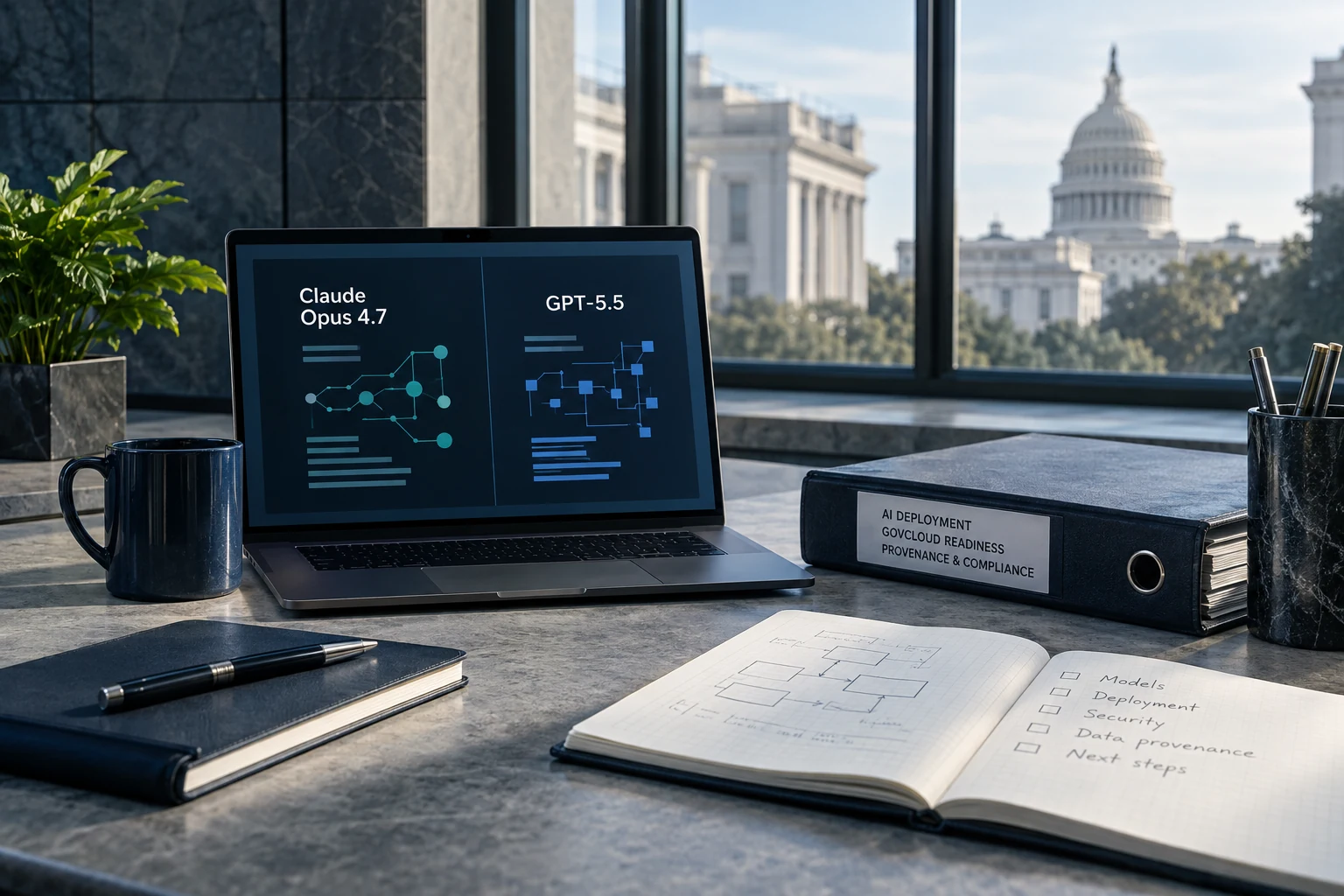
Update, July 2026: Anthropic shipped Claude Opus 4.8 on May 28, 2026. The pricing and benchmark comparison below reflects the April 2026 Opus 4.7 / GPT-5.5 snapshot; the decision framework carries over.
Claude Opus 4.7 is available on Amazon Bedrock commercially as of release day. Bedrock GovCloud availability for Opus 4.7 is expected within weeks-to-months based on prior Opus-tier cadence (Opus 4.6 reached GovCloud roughly six weeks after commercial). GPT-5.5 is available on commercial Azure OpenAI and rolling to Plus, Pro, Business, and Enterprise subscribers. Azure Government availability is not yet announced as of this writing. Neither model is yet authorized for CUI workloads in government regions.
What changed in Claude Opus 4.7
The Opus 4.7 release targets three dimensions that matter for federal agentic work. First, raw agentic-coding capability: SWE-bench Verified rose to 87.6%, SWE-bench Pro to 64.3%, CursorBench to 70%. For federal software-modernization workloads — legacy-system refactor, compliance-evidence generation, ATO artifact maintenance — those numbers translate into fewer failed long-horizon runs and tighter per-task token budgets.
Second, the Agent Teams primitive. Opus 4.7 exposes multi-agent orchestration as a first-class capability, not a library pattern you stitch together. In federal work this is load-bearing because auditability of multi-agent decision chains has been the single hardest part of deploying agentic AI inside an authorization boundary. When three agents cooperate to triage a FOIA request or assemble a compliance package, the ISSO and the AO want a traceable decision ledger, not a collapsed transcript. Native Agent Teams give us primitives for that ledger.
Third, the Compaction API. This is the one we expect to change federal deployment patterns the most. Compaction enables effectively unlimited agent conversations without context-window collapse — which matters most for long-running evidence-accumulation tasks (think a CMMC L2 SSP maintenance loop that runs over 18 months, or a continuous-ATO monitoring agent that needs to remember every control finding since last assessment). Before Compaction, those workflows required fragile external memory stacks. With it, the state can live inside the model provider's boundary.
What changed in GPT-5.5
GPT-5.5 lands a week later with a different emphasis. OpenAI positions it as stronger for agentic automation and long-horizon coding. From what we've seen in the initial rollout: better computer-use grounding, stronger deep-research-style workflows, and a broader tool-call ecosystem through the maturing Assistants API. The pricing moved: GPT-5.5 API input/output doubled from $2.50/$15 per million tokens to $5/$30, which puts it at near-parity with Claude Opus 4.7's $5/$25.
The price-doubling matters. For federal workloads with bounded budgets — Phase I SBIR at $140K-$250K, Phase II at $1.7M, multi-year GovCloud inference envelopes — a 2× price increase on the default frontier model resets every cost projection we wrote three months ago. It also closes the competitive gap between Claude and GPT at the API level, which means the decision factors that matter in federal work (authorization boundary, cloud alignment, fine-tune availability) carry even more weight.
The federal decision table, updated for April 2026
| Capability dimension | Claude Opus 4.7 | GPT-5.5 |
|---|---|---|
| SWE-bench Verified | 87.6% (released April 16) | Not yet publicly benchmarked in same frame |
| Multi-agent orchestration | Native Agent Teams primitive | Assistants API + custom orchestration |
| Long-horizon memory | Compaction API (effectively unlimited) | Larger context window, no compaction primitive |
| Pricing (input/output per M tokens) | $5 / $25 | $5 / $30 (doubled April 2026) |
| GovCloud availability | Expected weeks-to-months after April 16 commercial | Azure Government availability TBA |
| Auth boundary fit (AWS-anchored agency) | Native fit via Bedrock GovCloud | Cross-boundary movement required |
| Auth boundary fit (Azure-anchored agency) | Cross-boundary movement required | Native fit via Azure Government OpenAI |
| FY26 NDAA §1532 posture | US-provenance (Anthropic), compliant | US-provenance (OpenAI), compliant |
| Vision resolution | Tripled vs Opus 4.6 | Improved vs GPT-5 |
The commercial-to-GovCloud gap is the real story
In 2024, the commercial-to-government-region lag for a frontier model was typically 4-8 months. By early 2026, that had compressed to roughly 6-10 weeks for Opus-tier releases on Bedrock. With Opus 4.7 and GPT-5.5 landing a week apart, the federal buyer now has a reasonable expectation of both being available in GovCloud and Azure Government within the same calendar quarter.
That matters because it changes the risk profile of pinning an architecture to one model family. Prior to 2026, an agency that selected Claude in GovCloud in January would wait until summer for the next Opus release, during which time GPT-4.5 might have shipped commercially four months earlier. The commercial-to-GovCloud lag was a form of temporal lock-in. As the gap closes, that lock-in weakens. Agencies can credibly plan for "both-model" architectures where routing decisions happen at inference time based on workload fit, not vendor commitment.
For SBIR Phase II deliverables, we now recommend architecting with a provider-agnostic inference layer from the start. The cost of supporting both Claude and GPT call patterns has dropped to near-zero with LiteLLM, Portkey, and similar gateway stacks. The option value of being able to route to whichever frontier model ships first in GovCloud is worth the engineering.
What the April 2026 releases do NOT change
- The authorization boundary constraint. A new model is not a new boundary. Bedrock Claude Opus 4.7 in GovCloud remains FedRAMP High / IL4 / IL5 when it lands there — neither higher nor lower than Opus 4.6. Opus 4.7 on commercial Bedrock with real CUI remains a compliance violation regardless of how much better the model is.
- The prompt-injection attack surface. Agentic orchestration expands attack surface whenever a model gains the ability to call more tools with less oversight. The Agent Teams primitive in Opus 4.7 and the maturing Assistants ecosystem in GPT-5.5 both increase defensive-engineering burden. Input validation, tool-scope restriction, and output filtering still matter (we cover federal AI red-teaming here).
- The data-provenance documentation obligation. The requirement to document model provenance, training-data jurisdiction, and supply-chain controls in the SSP is not relaxed by a new release. Both Opus 4.7 and GPT-5.5 are US-provenance and compliant, but the documentation and attestation burden moves with every model-version change.
- The fine-tuning availability gap. Federal fine-tuning in government regions remains more constrained than commercial. An agency that wants to fine-tune a domain model on CUI data should confirm availability for the specific model version in the specific region before architecting.
The decision framework we use now
With Opus 4.7 and GPT-5.5 both in flight, our federal-customer advisory sequence has tightened to five questions:
- Q1: What is the target authorization boundary? Bedrock GovCloud favors Claude. Azure Government favors GPT. Multi-cloud or not-yet-anchored — continue to Q2.
- Q2: What is the impact level? IL4/IL5 supports both today (Opus 4.6 and GPT-5 currently; 4.7/5.5 when they land). IL6+ still routes to open-weight models on air-gapped infrastructure. FedRAMP High for civilian CUI works for both.
- Q3: What is the workload pattern? Long-horizon agentic evidence accumulation → Claude Opus 4.7 Compaction API is the distinguishing capability. Broad tool ecosystem with many third-party integrations → GPT-5.5 Assistants API is more mature. Narrow-scope structured reasoning → either works.
- Q4: What is the price sensitivity? With GPT-5.5 at $5/$30, the cost gap between the frontier tiers has closed to ~$5 per million output tokens. For budget-constrained SBIR work, that $5 matters. For multi-year enterprise deployment, the operational-familiarity cost dwarfs it.
- Q5: What is the provider-agnosticism plan? Architect a gateway so the same application can route to either. The April 2026 releases make the optionality worth the engineering.
Our internal production stack, as of April 24, 2026
For transparency: at Precision Federal, our own agentic development workflows run on Claude Opus 4.7 on commercial Bedrock for tasks that don't touch CUI, and we design federally-bounded architectures against the Opus tier in Bedrock GovCloud. We will move GovCloud-bound designs to Opus 4.7 when it lands in the government region, typically confirmed by AWS in their release-note cadence. Our inference routing uses a LiteLLM-based gateway so the same application can target Azure OpenAI GPT-5.5 when a customer's boundary is Azure-anchored — same prompts, different provider, no code change.
For SBIR Phase I deliverables in active preparation for June 2026 submission, we are building against Opus 4.6 in GovCloud with a documented upgrade path to 4.7. That is the defensible posture: specify the current authorized version in the proposal, commit to an upgrade SLA tied to AWS's GovCloud release, and don't pre-commit to a model-version that isn't yet authorized at the target impact level.
What we expect by mid-2026
Three things we're watching:
- Bedrock GovCloud availability of Opus 4.7. Expected late May to early July 2026 based on prior Opus cadence. AWS announces in release notes; we monitor and migrate.
- Azure Government OpenAI availability of GPT-5.5. Typically lags commercial by 6-12 weeks. Watch Microsoft's Azure Government What's New feed.
- Inference-economics shift from dedicated AI silicon. Google announced a next-generation inference-optimized chip family on April 20–22, 2026, with pricing and latency implications for agentic workloads. We examine GovCloud economics from this shift in a separate piece.
Frequently asked questions
Not as of April 24, 2026. Opus 4.7 is available on commercial Bedrock. GovCloud availability typically follows commercial by weeks-to-months. AWS announces via release notes.
Not as of April 24, 2026. GPT-5.5 is rolling out commercially to ChatGPT Plus, Pro, Business, Enterprise. Azure Government availability is not yet announced.
No. Architect for provider-agnostic inference now using the currently-authorized version of your target model (Opus 4.6 or GPT-5) and plan an upgrade path. Waiting is a bigger risk than migrating.
When Opus 4.7 reaches Bedrock GovCloud with Compaction API support, yes — inheritance flows through the Bedrock authorization. Confirm specific feature availability in release notes before architecting.
No. Existing GPT-5 deployments continue at GPT-5 pricing. GPT-5.5 API calls are priced at the new $5/$30 per million tokens. Plan migration costs accordingly.
Each model-version upgrade (e.g., Opus 4.6 → 4.7, GPT-5 → 5.5) is a significant change under NIST SP 800-37 RMF Step 6 continuous-monitoring criteria. Document the version, the authorization inheritance path (Bedrock GovCloud / Azure Government), and the risk delta. Many agencies require re-attestation for major model-version changes even when the boundary is unchanged.