
Army is the highest-volume DoD SBIR component
If you draw a map of DoD SBIR by topic count, Army covers the most ground. A typical cycle releases 80 to 120 Army topics, more than any other component. The volume is good news and bad news for a small firm. Good news because there are more chances to find a topic that fits your stack. Bad news because the topics are heterogeneous, the program offices behind them are many, and you cannot treat "Army SBIR" as a single buyer. You are actually dealing with ten to fifteen distinct buyers who happen to share a submission portal.
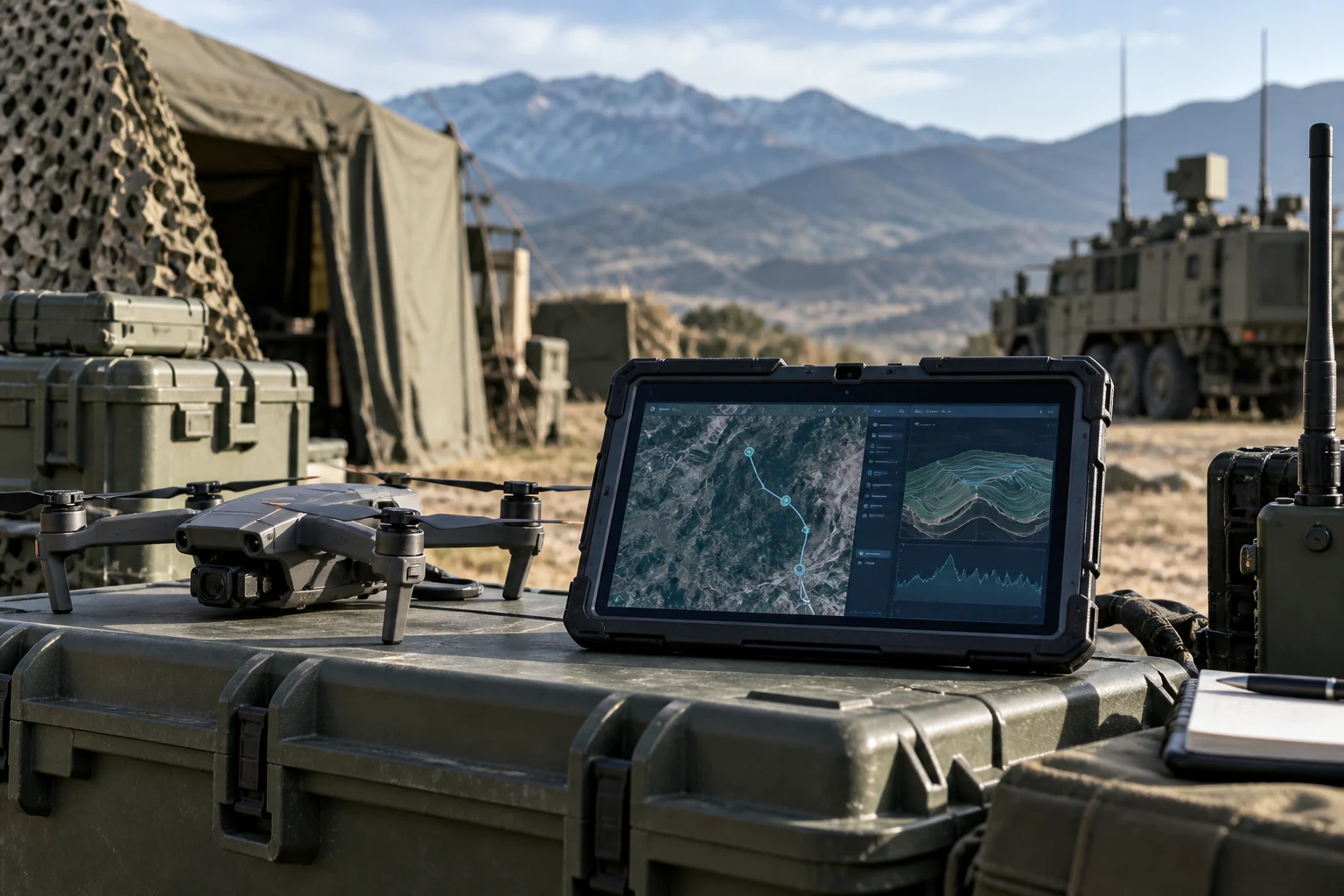
The Army funds more SBIR topics than any other DoD component. Army Futures Command and PEO IEW&S drive the majority of AI/ML demand. Topic selection should map to AFC's six modernization priorities.
This post lays out the structure — who writes Army topics, how the 2026 cycles land on the calendar, how xTechSearch overlays with SBIR, and where an AI-first small business should actually compete. It is meant for a firm that can deliver code and models, not one that writes proposals for hire.
The program office structure behind Army topics
Army SBIR topics originate from three kinds of organizations: DEVCOM centers, PEO program offices, and Army Futures Command cross-functional teams. Each has its own culture, its own problem statements, and its own review style.
DEVCOM centers
DEVCOM (Combat Capabilities Development Command) is the engineering heart of Army research. It runs eight centers, several of which generate meaningful SBIR volume every cycle:
- DEVCOM C5ISR Center (Aberdeen, MD) — command, control, communications, computers, cyber, ISR. Heaviest AI buyer inside Army SBIR. Topics on sensor fusion, tactical networks, and cyber ML appear every cycle.
- DEVCOM Aviation and Missile Center (AvMC) (Redstone, AL) — aviation platforms, missile systems, air and missile defense. Predictive maintenance topics and autonomy topics cluster here.
- DEVCOM Ground Vehicle Systems Center (GVSC) (Warren, MI) — combat and tactical vehicles. Autonomy, condition-based maintenance, and digital engineering topics.
- DEVCOM Armaments Center (Picatinny, NJ) — weapons, munitions, fire control. More mechanical than AI, but fire control AI and counter-UAS topics appear.
- DEVCOM Analysis Center (DAC) (Aberdeen, MD) — modeling, simulation, operations research. Small but AI-heavy when it does post topics.
- DEVCOM Chemical Biological Center (Aberdeen, MD) — CBRN detection and protection. Overlaps with DTRA work.
- DEVCOM Soldier Center (Natick, MA) — individual soldier systems, textiles, nutrition. Smaller SBIR volume.
- DEVCOM Army Research Laboratory (ARL) — basic and applied research. ARL topics tend to be more speculative and research-heavy.
PEO program offices
Program Executive Offices manage acquisition programs of record. Their SBIR topics have something DEVCOM topics sometimes lack: a clear customer and a clear follow-on dollar. PEOs that generate AI-adjacent SBIR topics include PEO Intelligence, Electronic Warfare and Sensors (PEO IEW&S), PEO Aviation, PEO Ground Combat Systems, PEO Combat Support and Combat Service Support, and PEO Soldier. When a topic comes from a PEO, the transition path is more legible — you know which program of record is funding and who the government PM is.
Army Futures Command cross-functional teams
AFC runs the cross-functional teams (CFTs) that organize around specific modernization priorities: Long Range Precision Fires, Next Generation Combat Vehicle, Future Vertical Lift, Network, Air and Missile Defense, and Soldier Lethality. CFTs do not write SBIR topics directly very often, but the priorities they articulate shape what DEVCOM centers and PEOs ask for. Reading a CFT's published modernization priorities is the easiest way to predict which Army SBIR topics will be funded.
The 2026 Army SBIR calendar
Army participates in the DoD SBIR joint release schedule. In 2026 the Army-relevant releases are:
| Release | Pre-release | Opens | Closes | Approx. Army topics |
|---|---|---|---|---|
| 25.4 Release 12 | Mid-April 2026 | April 23, 2026 | May 13, 2026 | ~50-70 Army topics (partial cycle) |
| 26.1 Release 1 | May 2026 | May 7, 2026 | June 3, 2026 | ~90-120 Army topics |
| 26.2 Release 2 | August 2026 | Sept 2026 | Oct 2026 | ~80-110 Army topics |
| 26.3 Release 3 | November 2026 | Dec 2026 | Jan 2027 | ~70-100 Army topics |
Army also runs its own direct-to-Phase-II (D2P2) and Phase II Enhancement opportunities between releases. These are worth tracking if you have prior Phase I work, whether at Army or another agency. D2P2 requires documentation that the technology has reached the Phase II starting point through other funding — OSD, prior SBIR, or private.
xTechSearch: the prize-plus-introduction overlay
xTechSearch is the Army's prize competition program. It is not a contract, but it is a legitimate path into the Army ecosystem. The mechanics: a firm submits a short technical concept, progresses through pitch rounds, and wins cash prizes at each stage. The real value is not the prize money — it is the introductions. xTech finalists and winners get matched to Army program offices, briefed on relevant SBIR topics, and in some cases invited to direct-to-Phase-II opportunities.
For a firm with strong tech but no federal past performance, xTechSearch is a reasonable parallel track. The written concept is short, the time investment is manageable, and the downside is a few weeks of work. Firms that win xTech and convert to SBIR in the same fiscal year tend to have materially higher Phase I win rates on the topics they target, because the program office already knows their team.
Warm topic areas for AI firms in 2026
Editorial weighting from public sources and practitioner reading — illustrative, not a measured statistic.
Based on prior cycle patterns, AFC CFT priorities, and the fiscal 2026 budget directives, the Army SBIR topic areas most open to a small AI firm without deep Army incumbency are:
Predictive maintenance and condition-based maintenance
AvMC, GVSC, and PEO Aviation post predictive maintenance topics every cycle. The Army has published data from its Integrated Data Environment (IDE) and the Logistics Modernization Program (LMP) that is usable for ML work once you have the right data access. Topics tend to focus on specific platforms: AH-64 Apache, UH-60 Black Hawk, Abrams M1A2, Stryker. A firm with prior ML-on-time-series work can compete credibly if it can articulate a clear path from historical maintenance records to deployable anomaly detection at the tactical edge.
Tactical logistics AI
The Army has an explicit modernization priority around contested logistics. Topics show up at DEVCOM Ground Vehicle, Army Sustainment Command, and the Logistics CFT. Real problems: demand forecasting at the forward support battalion level, last-tactical-mile routing under jamming, predictive parts sourcing. Data is uneven but there is a lot of it.
Intelligence processing and sensor fusion
PEO IEW&S, C5ISR Center, and INSCOM generate the highest-density AI topics. Problems include multi-INT fusion, signal processing for electronic warfare, SAR/EO/IR object detection, and natural language processing for OSINT. Classification is a gating factor — a firm without cleared personnel cannot work the classified variants but can still compete on unclassified enabling technology.
Autonomy and counter-autonomy
Ground and aerial autonomy topics appear every cycle. GVSC publishes Robotic Combat Vehicle related topics. AvMC publishes Future Vertical Lift autonomy topics. PEO Aviation publishes Launched Effects topics. Counter-UAS sits across Armaments Center and IEW&S.
Digital engineering and model-based systems
Less hyped than autonomy but steadier. Topics around digital twins, MBSE tooling, automated requirements checking, and simulation at scale appear across multiple DEVCOM centers. For a firm that can blend ML with engineering workflow tooling, this is underpriced.
Who wins Army SBIR topics, and why
Pattern recognition from the last five cycles of Army awards:
Incumbents win AvMC topics
A small set of firms has won AvMC predictive maintenance topics repeatedly. Breaking in requires either a differentiated technique (not just "we fit a model to the same data") or a teaming path with one of the incumbents.
First-time firms win C5ISR topics at a reasonable rate
The topic breadth is high enough that newcomer AI firms can get a first win here if the technical approach is clearly stronger than the median proposal.
PEO topics reward transition clarity
Firms that name the program of record and a plausible Phase III customer in the first paragraph of the proposal tend to advance.
GVSC topics reward engineering depth
Pure ML pitches underperform here; ML plus real-time systems, embedded compute, or mechanical engineering depth outperforms.
Practical steps for a first Army SBIR cycle
- Read the topic titles for the prior two cycles. Patterns are visible. You can often tell which DEVCOM center will re-post a topic before the pre-release.
- Pick two DEVCOM centers and one PEO. Not more. Depth in three buyers beats breadth across ten.
- Contact the TPOC during pre-release. The Technical Point of Contact window is where legitimate conversations happen. Use it. Ask about the underlying problem, not about the proposal format.
- Write to the problem, not to the topic. Topic language is often written to a specific unmet need. Reviewers reward proposals that name that need and show they understand the operational context.
- Name the transition. Even a rough Phase III story — which unit, which program office, which follow-on vehicle — lifts a proposal out of the generic pile.
- Submit on time with room to spare. DSIP portal issues in the last hour are a recurring cause of last-minute disqualifications.
The Army-specific failure modes
Failure modes that are more Army than anywhere else:
Writing to the Army as a single customer
The reviewers are from one program office. They want their problem solved, not DoD's problem.
Ignoring the incumbent landscape
If a topic has been posted three cycles running and the same firm has won it twice, you are not going to take it from them with a clever proposal. Go to a different topic.
Treating xTech as a replacement for SBIR
xTech is a complement. Both-and, not either-or.
Ignoring cybersecurity and data rights language
Army SBIR contracts have specific data rights and cybersecurity clauses. Phase II contracts flow through to DFARS 252.204-7012. You need CUI-capable systems before Phase II, not after.
Bottom line
Army SBIR in 2026 is the largest single stream of federal AI topic volume. It rewards firms that treat it as a structured portfolio across DEVCOM, PEO, and AFC-priority topics, not a single lottery ticket. The warm areas — predictive maintenance, tactical logistics, intelligence processing, autonomy, digital engineering — each have a small set of incumbent firms and enough topic volume that a strong first-time firm can win one or two per cycle with focused effort. The firms that do well treat the program office as the customer, not the DSIP portal.
Frequently asked questions
Army releases 80 to 120 topics per cycle across DEVCOM, PEOs, and the Army SBIR PMO. The 25.4 cycle opening April 23, 2026 includes roughly 50-70 Army topics; the 26.1 cycle closing June 3, 2026 is larger at 90-120.
Phase I is up to 250 thousand dollars over roughly three to six months. Phase II is up to 2 million over 12 to 18 months. Direct-to-Phase-II paths exist with prior tech maturation evidence.
xTechSearch is a prize competition, not a contract. Finalists are matched to Army program offices and sometimes invited to direct-to-Phase-II opportunities. It is a legitimate complement to SBIR, not a replacement.
DEVCOM C5ISR Center, DEVCOM Aviation and Missile Center, and PEO Intelligence, Electronic Warfare and Sensors. DEVCOM Analysis Center and AFC cross-functional teams also drive AI topic priorities.
Volume is higher, so the pool of winnable topics is larger. Aggregate rate is 12-18 percent. Narrowly scoped topics run below 10 percent; broader topics sit above 20. Choose topics, not averages.
Reach out to the TPOC during pre-release. Write to the program office problem. Name the transition path — unit, program of record, follow-on vehicle. Generic AI proposals lose every time.