Higher score = more public-literature consensus and standards maturity.
The sustainment problem in public
Army sustainment logistics — the system that keeps fielded equipment operational — has a long-standing parts-availability problem for legacy systems where original manufacturers have exited the market. Additive manufacturing is the publicly stated mitigation: print the part on demand at the point of need. The open research question is how to make on-demand AM trustworthy enough that the resulting parts can be installed in safety-relevant systems without an exhaustive retest of every print.
Process monitoring, defect detection, qualification, and the lab-to-field transfer gap. Field-deployed printers face vibration, temperature swings, and operators with broader responsibilities than dedicated lab printers.
The public Army documentation grounds the problem precisely. The Army Additive Manufacturing Implementation Plan, the AMC and TACOM-led depot modernization work, and the Combat Capabilities Development Command (DEVCOM) Army Research Laboratory publications collectively describe the parts-obsolescence problem and the AM mitigation pathway. The supporting standards work is well underway: ASTM F42 and ISO/TC 261 publish the consensus technical-specification series; ASTM F3434 and the AMS7000-series specifications cover qualification of AM parts for aerospace and defense applications.
The trustworthiness question is the binding constraint. A part that is dimensionally correct but contains a porosity defect at a stress-concentrating geometry can fail catastrophically. The published failure-analysis literature documents specific examples — fatigue cracks initiating at lack-of-fusion porosity, residual-stress-driven distortion in thick-section builds, anisotropic mechanical properties along the build direction. The methodology that addresses these is not single-modality monitoring; it is layered evidence — material certification, in-process monitoring, post-process NDE, and mechanical-coupon witness testing — combined into a defensible per-part record.
Process monitoring with ML
The public AM-process-monitoring literature has matured substantially over the last five years. Melt-pool imaging, acoustic emission, and thermal sensing each generate signals that correlate with the most common defect classes. Convolutional and recurrent architectures applied to these sensor streams are now routinely demonstrated in academic and DOE-funded labs. The unsolved problem is generalization: a model trained on one alloy, one machine, and one parameter set rarely transfers cleanly to another. The literature treats this as a transfer-learning and domain-adaptation problem and has documented mixed results.
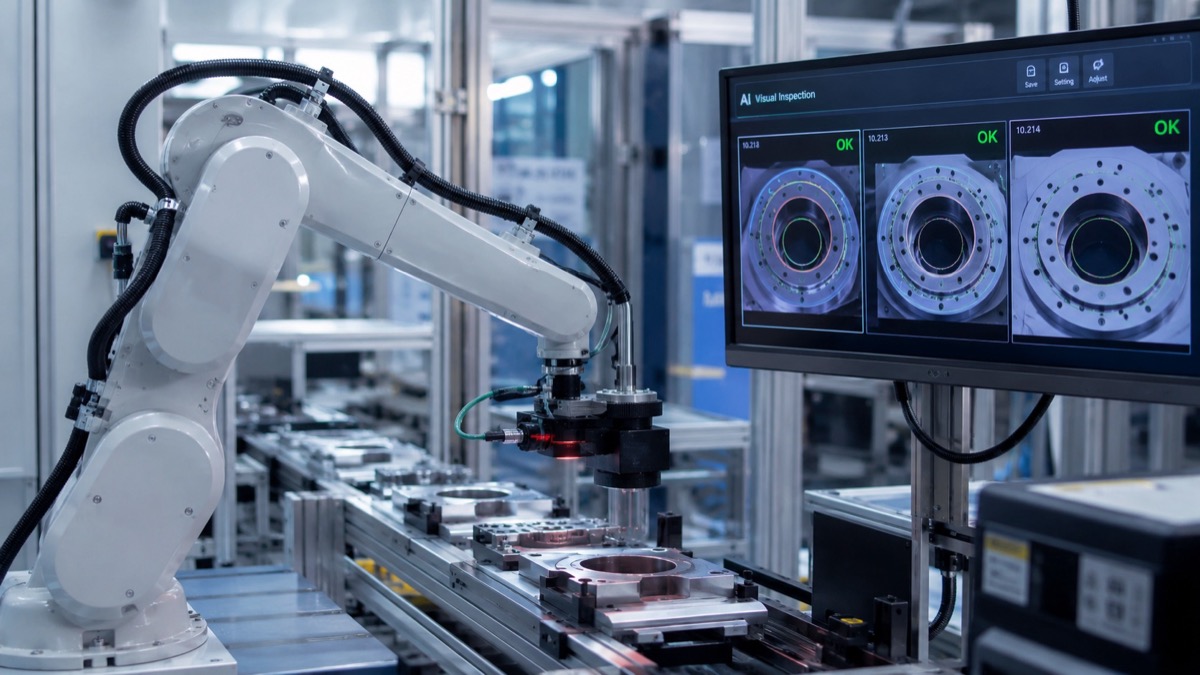
The specific sensor-modality work has clear public anchors. NIST's Engineering Laboratory operates the Additive Manufacturing Metrology Testbed (AMMT) and has published melt-pool imaging datasets and benchmarks. The DOE Manufacturing Demonstration Facility at Oak Ridge National Laboratory publishes process-monitoring work on its laser powder-bed fusion and electron-beam systems. America Makes — the National Additive Manufacturing Innovation Institute — coordinates much of the cross-laboratory benchmark work. ASTM F3490 (the new in-process monitoring standard) and ISO/ASTM 52939 codify what a credible monitoring claim looks like.
The architecture choices in the published comparisons are converging. For melt-pool imaging, U-Net-style segmentation networks identify per-frame anomalies; recurrent or transformer architectures aggregate the per-frame signals across a build layer. For acoustic emission, time-frequency representations (continuous wavelet transforms, short-time Fourier transforms) feed convolutional classifiers. For thermal imaging, physics-informed neural networks that incorporate the heat-transfer governing equations have shown improved generalization across machines. The published consensus is that single-modality monitoring rarely suffices for safety-relevant qualification.
Defect detection and qualification
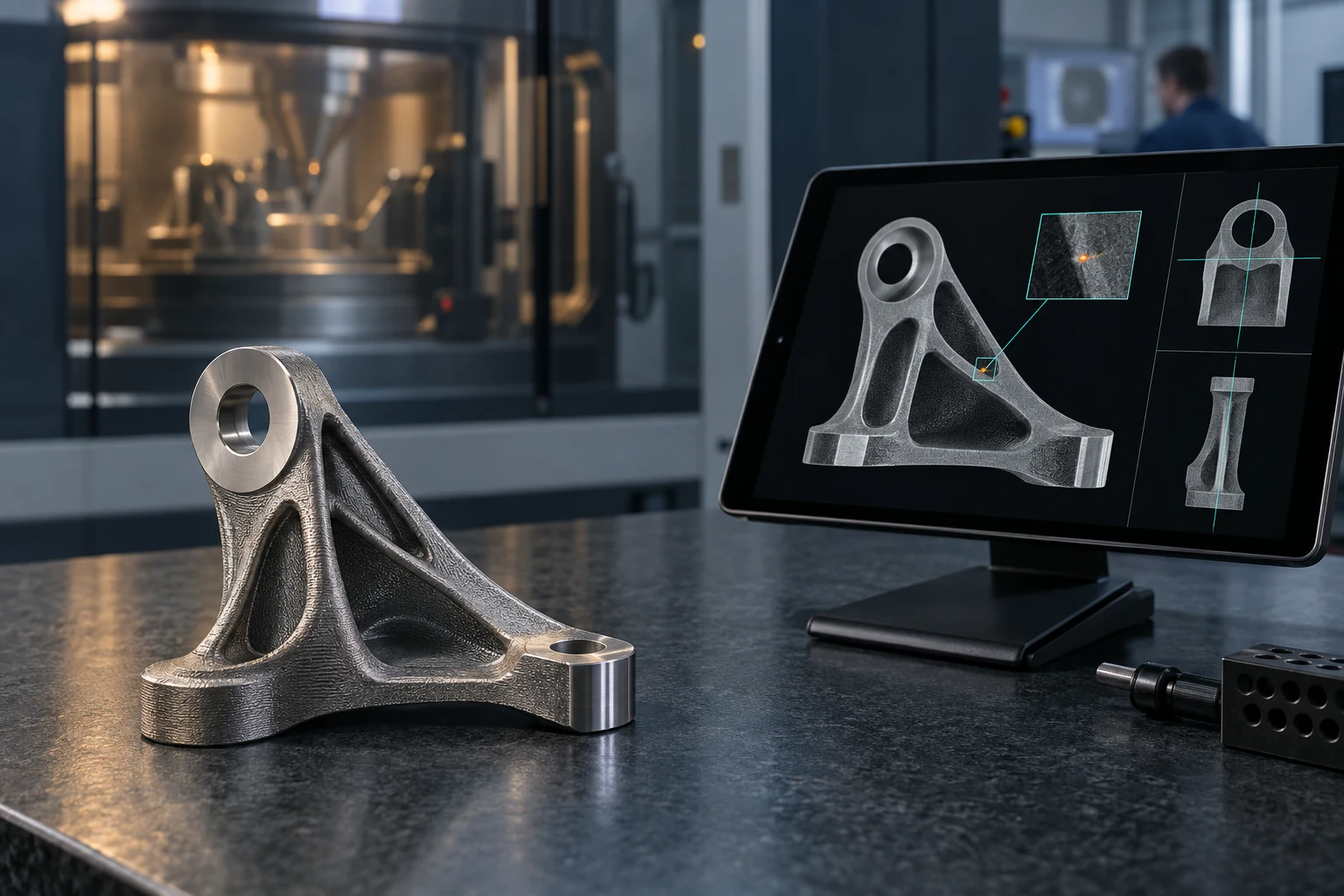
Defect detection — porosity, lack-of-fusion, residual stress, dimensional deviation — is the traditional bottleneck for AM qualification. The published nondestructive evaluation (NDE) literature has demonstrated that several modalities (X-ray CT, ultrasound, eddy current) can find defects of operationally relevant sizes. The integration of in-process sensing with post-process NDE is the active research frontier. For sustainment specifically, the methodology that scales is the one that allows certification on a per-part basis without a full mechanical test campaign.
The defect taxonomy is well-codified. ASTM E1316 and ISO/ASTM 52900 enumerate the discontinuity classes the community recognizes. The probability-of-detection (POD) methodology from MIL-HDBK-1823A and the equivalent civil-aviation guidance (FAA AC 25.1529) define how NDE sensitivity is reported. Published comparisons of micro-CT, phased-array ultrasonic testing, and laser-ultrasonic methods show different sensitivities to different defect classes; no single modality wins across the board. The published consensus is that complementary modalities, paired with the in-process record, give the strongest qualification claim.
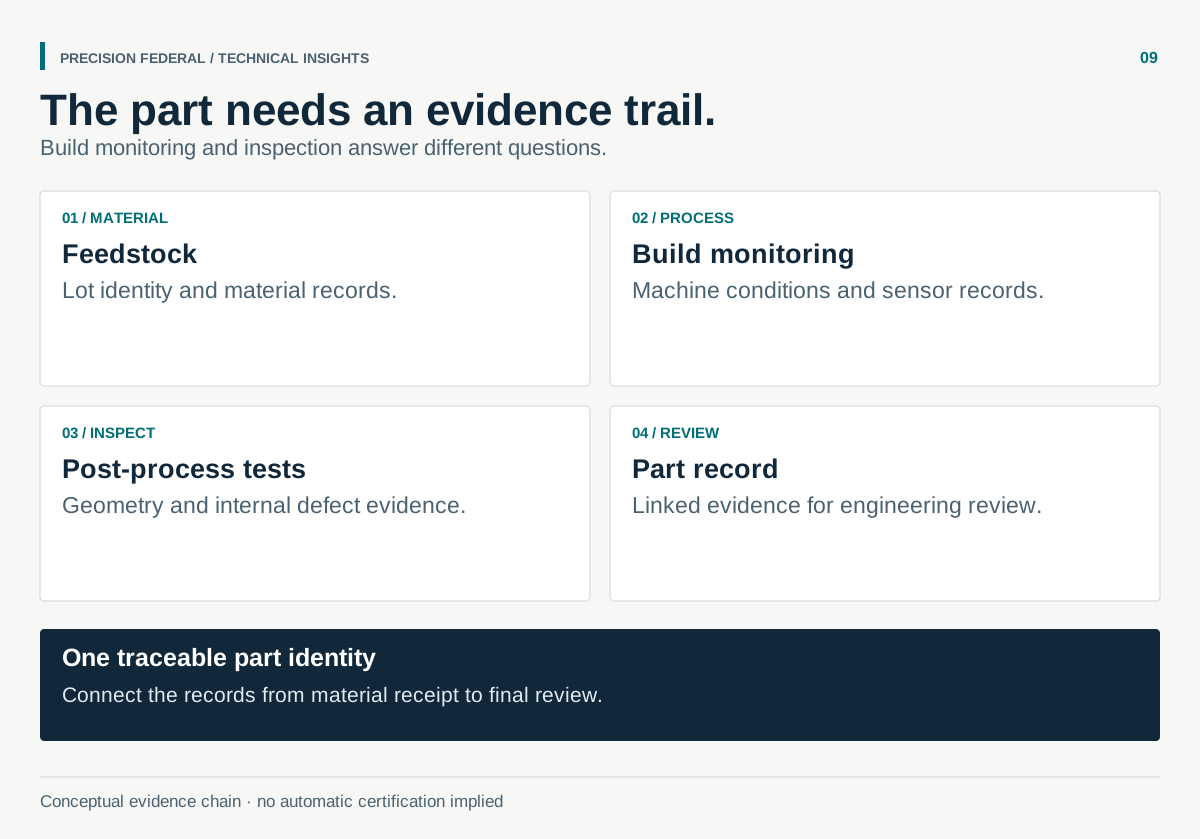
The integration challenge is software, not hardware. Tying the in-process sensor stream to the post-process NDE result to the mechanical-coupon validation to the part-level certificate of conformance is a data-modeling problem with deliverable software, not a sensor problem. The Digital Thread / Digital Twin work funded under various Office of the Secretary of Defense initiatives — and the related NIST Cybermanufacturing program — provides the conceptual framing. The published work consistently identifies the data-integration layer as the binding constraint on per-part certification at scale.
Materials and process windows
Public AM materials databases — including those maintained by NIST, NASA, and several university consortia — are improving but remain incomplete. For Army-relevant alloys (high-strength steels, specific aluminum and titanium grades), the published process windows are narrower than the practitioner community would prefer. Bayesian optimization and active learning have appeared in the literature as ways to map process windows efficiently with limited experimental budget. The methodological discipline is to be explicit about the prior assumptions and to report the experimental cost honestly.
The specific public databases worth naming are concrete. NIST's Additive Manufacturing Materials Database, NASA's MAPTIS system (with restricted access for some entries), and the Senvol Database aggregate the published mechanical-property data on AM parts. The MMPDS Handbook covers the conventionally manufactured baselines that AM parts must equal or exceed for substitution. The published process-window work in journals like Additive Manufacturing and Materials & Design documents the laser power, scan speed, hatch spacing, and powder-bed parameters that yield acceptable density and microstructure for specific alloy systems.
The Bayesian-optimization literature for AM process discovery has a well-anchored set of references — Mondal, Bhattacharya, and others have published on Gaussian-process-based parameter exploration; Tapia and others on multi-fidelity Bayesian optimization that combines simulation and experimental data. The methodological honesty that the published work emphasizes — reporting the experimental budget, the prior assumptions, the convergence behavior — is what separates a credible process-window claim from a marketing assertion.
Field deployment realities
The lab-to-field gap for AM is large. Lab printers operate in temperature-controlled rooms with calibrated power inputs and dedicated maintenance. Field printers — at depots, forward operating bases, or on ships — face vibration, temperature swings, varying power quality, and operators with broader responsibilities. The open literature on field-AM is thinner than the lab literature and is dominated by anecdotal case studies. This is itself a research gap that software can help close, especially around process-condition monitoring and alerting.
The Army's existing infrastructure provides the integration target. The Rock Island Arsenal Joint Manufacturing and Technology Center, the Anniston Army Depot, the Letterkenny Army Depot, and the various TACOM and AMC depot sites operate AM equipment for sustainment use today. The Marine Corps' X-FAB expeditionary fabrication labs and the Navy's REPTX and similar programs likewise show the operational direction. Software that helps these existing operators produce defensible per-part records is a more tractable contribution than software that proposes a new manufacturing paradigm.
Software-first opportunities
For a software-first small business, the addressable surface in this domain is the software stack: process planners that respect machine-specific calibration, in-process monitors that produce auditable evidence, qualification tools that integrate sensor data into a part-level certificate of conformance, and digital threads that survive the move from depot to field. None of these requires the SBIR offeror to manufacture parts; they require the offeror to write software that helps a Soldier do so with auditable confidence.
The named opportunity classes are concrete. Slicer and process-planner software with machine-specific calibration support. Sensor-integration middleware that handles the heterogeneous output of melt-pool cameras, pyrometers, acoustic sensors, and machine-state telemetry. Qualification record systems that bind the build record, the NDE result, and the witness-coupon test data to a per-part identifier. Digital-thread tooling that respects the supply-chain provenance from feedstock lot through final part installation. Each of these is a software contribution with measurable improvement potential and a clear customer at the depot or arsenal level.
Public AM Standards and Frameworks a Reader Should Know
ASTM F42 / ISO/TC 261. The consensus AM standards committees and their published technical-specification series.
ASTM F3434, AMS7000-series, ASTM F3490. Qualification, mechanical, and in-process monitoring standards.
NIST AMMT, ORNL MDF, America Makes. The public process-monitoring testbeds and benchmark datasets.
NIST AM Materials Database, MMPDS, Senvol. The public material-property and process-window references.
Why this work matters to us
Precision Federal is a software-only SBIR firm. The reason articles like this one exist on this site is simple: federal program offices fund teams whose principal investigators have demonstrated, in public, that they think carefully about the problems the program is trying to solve. We write to demonstrate that posture, not to telegraph any particular technical approach. If your office is exploring the problem class above and wants a partner who reads the literature, codes the prototypes, and ships under a Phase I or Direct-to-Phase-II SOW, we are listening.
Common questions on the public-record framing
What public AM standards anchor the Army's qualification posture?
ASTM F42 / ISO/TC 261 process standards, ASTM F3434 for design intent, AMS7000-series for materials, and ASTM E1316 / MIL-HDBK-1823A for NDE. The Army AM Implementation Plan is the public posture.
Where do in-process sensing and post-process NDE meet?
Integration of melt-pool imaging, acoustic emission, and thermal sensing with X-ray CT and ultrasound on a per-part certification basis. The methodology that scales avoids a full mechanical test campaign per part.
Why is the lab-to-field transfer gap large?
Lab printers run in temperature-controlled rooms with calibrated power and dedicated maintenance. Field printers face vibration, temperature swings, and operators with broader responsibilities. The published field-AM corpus is thinner than the lab corpus.
What does this article not cover?
Specific Army parts in inventory, specific depot capacity, or any Precision Federal qualification methodology.
Public AM-AI method classes
| Class | Method | Maturity |
|---|---|---|
| In-process sensing | Melt-pool imaging, acoustic emission, thermal | Multiple peer-reviewed labs |
| ML defect detection | CNN, RNN, U-Net on sensor streams | Generalization across machines is the gap |
| Materials databases | NIST AM Bench, NASA MAPTIS, Senvol | Public references improving |
| Standards | ASTM F42 / ISO/TC 261, ASTM F3434, AMS7000 | Active and growing |
| NDE integration | X-ray CT, ultrasound, eddy current | Combined with in-process for per-part certification |
Frequently asked questions
Army sustainment logistics has a long-standing parts-availability problem for legacy systems where original manufacturers have exited the market. The publicly stated mitigation is to print the part on demand at the point of need. The open research question is how to make on-demand AM trustworthy enough to install in safety-relevant systems without an exhaustive retest of every print.
Melt-pool imaging, acoustic emission, and thermal sensing each generate signals that correlate with the most common defect classes. Convolutional and recurrent architectures applied to these sensor streams are now routinely demonstrated in academic and DOE-funded labs.
A model trained on one alloy, one machine, and one parameter set rarely transfers cleanly to another. The literature treats this as a transfer-learning and domain-adaptation problem and has documented mixed results.
Process planners that respect machine-specific calibration; in-process monitors that produce auditable evidence; qualification tools that integrate sensor data into a part-level certificate of conformance; and digital threads that survive the move from depot to field. None of these requires the offeror to manufacture parts.