Editorial weighting from public sources and practitioner reading — illustrative, not a measured statistic.
Higher score = stronger validation discipline in the published record.
The active sonar problem in public
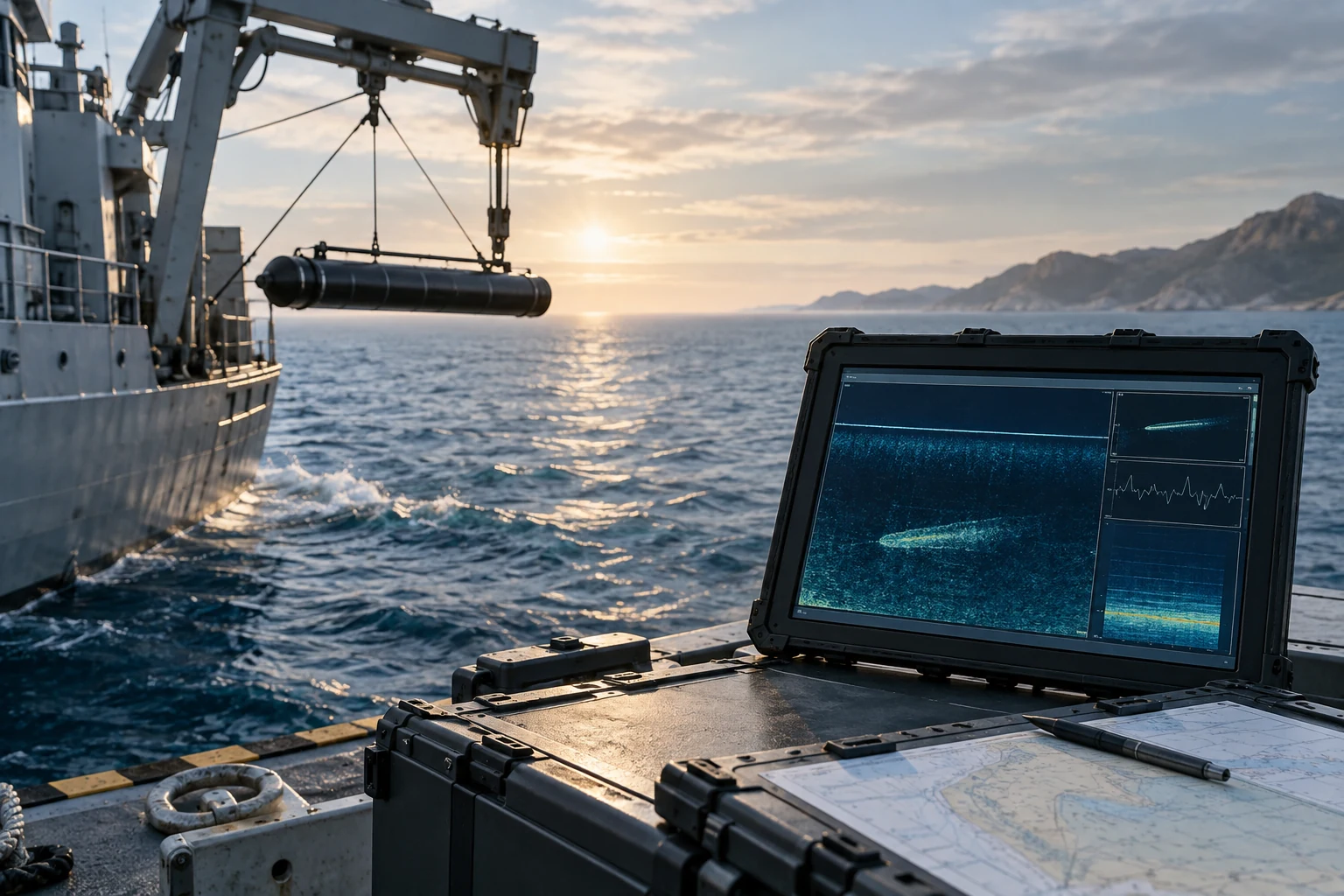
Active sonar emits acoustic energy and processes the returning echoes to detect, localize, and classify objects underwater. The publicly available signal-processing literature is decades deep, with solid baselines for the detection and localization stages. Classification — distinguishing classes of returns — has historically been the harder problem and is where modern ML methods have made the most ground.
Deterministic signal-processing front ends remain essential. Convolutional baselines are strong; transformer approaches show promise but have not consistently displaced CNN baselines on public benchmarks.
Signal-processing front ends
The deterministic front end of a modern sonar pipeline — beamforming, normalization, time-frequency representations — remains essential. Spectrograms, time-frequency representations of matched-filter output, and wavelet decompositions feed the learning stages; cepstral and modulation-spectrum features have also been useful in some studies. The published research is consistent that these front ends should be physics-grounded; learned end-to-end pipelines that skip the deterministic preprocessing have not produced reliable improvements on independent data.
The peer-reviewed canon on this is broad. Van Trees's detection-and-estimation textbooks remain the standard reference for the underlying theory. The IEEE Journal of Oceanic Engineering, the Journal of the Acoustical Society of America, and the Underwater Acoustic Signal Processing Workshop publish steady streams of relevant work. Open-source toolboxes — including the various academic implementations of beamforming and matched-filter pipelines — give offerors a way to produce reproducible baselines.
Physics-based synthetic data generated through propagation models (the public Bellhop ray-tracing code, the parabolic-equation-based RAM and KrakenC implementations, and the broader OALIB community) is increasingly used to augment scarce real data. The methodological discipline is to keep the front end interpretable enough that engineers can reason about its failure modes; opaque pipelines that pass training-set evaluation but fail on independent data are the recurring trap.
Architectures that have survived peer review
Convolutional networks applied to time-frequency representations have been the workhorse architecture for active-sonar classification, with peer-reviewed results across multiple decades. Recent work on transformer-based approaches (audio spectrogram transformers and successors) and time-series foundation models shows promise but has not consistently displaced strong convolutional baselines on the public benchmarks where comparison is possible.
Multi-task and contrastive-learning frameworks (SimCLR, MoCo, and their audio-domain adaptations) improve robustness when training data is scarce, particularly for the rare-class problem that sonar classification always faces. Self-supervised pretraining on unlabeled hydrophone data, followed by supervised fine-tuning on labeled subsets, is an active area in the published literature with credible results on open benchmarks.
The methodological discipline is to compare to a strong convolutional baseline on a credible test split; novel architectures need to clear that bar before they earn operational consideration. Reviewers are tired of architecture-of-the-year papers that compare against weak baselines on convenient data; offerors who lead with a strong baseline and demonstrate where the new method actually helps score better.
Public datasets and the data-scarcity problem
Publicly available sonar datasets are limited compared to image classification. Several university and government laboratories have released benchmark sets — including academic releases from MIT Lincoln Laboratory, the Naval Postgraduate School, and the European NATO Centre for Maritime Research and Experimentation (CMRE) on related problems — and synthetic-data pipelines based on physics simulators are now common.
The methodological honesty required is to report performance on real held-out data, not just on synthetic, and to characterize the synthetic-real gap where it exists. The published domain-adaptation literature gives offerors a vocabulary for treating the gap explicitly: domain-adversarial training, covariate-shift correction, importance weighting, and test-time adaptation are all credible methods, but each has assumptions that the peer-reviewed evaluations make clear.
Few-shot and meta-learning methods (Prototypical Networks, MAML, and successors) deserve attention in a domain where new target classes appear faster than labeled data accumulates. The methodological pattern that scales is curated dataset versioning, careful split discipline, and honest reporting of what the system has and has not seen.
Calibration and decision support
Sonar classifications are inputs to operator decisions, not autonomous actions. The public human-factors literature on sonar operator workload emphasizes confidence calibration: operators need to know when the system is uncertain. Modern probabilistic ML and Bayesian deep-learning approaches address calibration directly, and several published studies show measurable improvements in operator decision quality when calibration is properly handled.
The peer-reviewed toolkit is mature. Temperature scaling and the broader post-hoc calibration literature (Guo et al., ICML 2017 and the follow-on work) give offerors well-characterized methods. Conformal prediction provides distribution-free coverage guarantees that map naturally to operator-facing confidence intervals. Deep ensembles, Monte-Carlo dropout, and SWAG-style approaches give epistemic uncertainty alongside aleatoric uncertainty. The Lee-See trust-in-automation framework and successor work give offerors a vocabulary for connecting calibration to operator behavior.
Out-of-distribution detection is the companion problem. The published OOD-detection literature (Mahalanobis-distance-based methods, energy-based scores, and the more recent foundation-model-based detectors) gives offerors a way to flag inputs the system was not trained for, which is essential when operational data drifts away from training conditions.
What software-first firms can usefully build
The addressable surface for software-first firms includes the data-engineering pipeline (annotation, dataset versioning, train/test split discipline), the training infrastructure (reproducible runs, hyperparameter tracking, model versioning), the evaluation harness (calibration metrics, slice analysis, OOD detection), and the operator-facing tooling (confidence display, anomaly explanation). These are software-engineering deliverables that complement, rather than replace, the underlying signal-processing expertise.
Concrete public-toolchain references that map well include MLflow and Weights & Biases for experiment tracking, DVC and LakeFS for data versioning, Hydra for configuration management, Great Expectations for data validation, and the various open-source MLOps stacks. The methodological discipline that scales is to make every model run reproducible from a known commit, a known dataset hash, and a known configuration — and to make every operational result traceable back to the run that produced it.
For Phase II, the strongest scopes pair the software substrate with measurable improvements on a defined operational metric and a clear transition path to a customer office that already funds related work. The published agency programs in undersea sensing give offerors enough public framing to identify candidate transition partners without needing access to non-public material.
Active-Sonar ML Discipline — Public Substrates by Stage
| Stage | Public methods and tooling | Validation discipline |
|---|---|---|
| Front end | Beamforming, matched-filter, wavelets, Bellhop/RAM/KrakenC | Physics-grounded; interpretable failure modes |
| Architecture | CNN baselines; AST/transformers; SimCLR/MoCo pretraining | Compare to strong baseline before claiming improvement |
| Data | NPS/MIT-LL/CMRE releases; physics-based synthesis; domain adaptation | Real held-out evaluation; characterized synthetic-real gap |
| Calibration | Temperature scaling, conformal prediction, deep ensembles, MC-dropout | Calibration metrics in the harness, not as an afterthought |
| OOD detection | Mahalanobis, energy-based, foundation-model detectors | Flagged unseen distributions; operator notification |
| Infrastructure | MLflow/W&B, DVC/LakeFS, Hydra, Great Expectations | Reproducible runs from commit, data hash, config |
How we use this site
We write articles like this to make our reading visible — what we think the open literature says, what we think the open gaps are, and where careful work might land. We do not use these pages to preview proposed approaches in active program spaces. Precision Federal is a software-only SBIR firm. If your office is funding work in this area and would value a software-first partner with a documented public-reading habit, we welcome the introduction.
Common questions on the public-record framing
Why do hybrid pipelines outperform end-to-end ML?
Deterministic front ends — beamforming, normalization, time-frequency representations — remain essential. Learned end-to-end pipelines that skip the deterministic preprocessing have not produced reliable improvements on independent data.
How is calibration evaluated in published sonar ML work?
Guo et al. temperature scaling, conformal prediction, deep ensembles, and MC-dropout. Operator decisions depend on calibrated confidence, not just point predictions.
What does this article not cover?
Specific platform integrations, specific waveforms or frequencies, or any Precision Federal active-sonar architectural approach.
Frequently asked questions
Because the published research is consistent that learned end-to-end pipelines which skip beamforming, normalization, and time-frequency analysis have not produced reliable improvements on independent data. The deterministic front end encodes decades of acoustic engineering that the learning stage benefits from rather than has to rediscover from limited training data.
Against strong convolutional baselines on time-frequency representations, on the public benchmarks where comparison is possible. Transformer-based and foundation-model approaches show promise but have not consistently displaced convolutional baselines on independent data. The methodological discipline is to clear that bar before claiming improvements.
Because classifications feed operator decisions, not autonomous actions. The published human-factors literature shows measurable improvements in operator decision quality when the system can communicate uncertainty honestly. Probabilistic ML and Bayesian deep-learning approaches address calibration directly and are part of the validation expectation.
The data-engineering pipeline (annotation, dataset versioning, train/test split discipline), the training infrastructure (reproducible runs, hyperparameter tracking, model versioning), the evaluation harness (calibration metrics, slice analysis, out-of-distribution detection), and the operator-facing tooling for confidence display and anomaly explanation.