
Why this tour exists
Every federal agency now publishes a list of where it uses artificial intelligence. In April 2026 the Office of Management and Budget consolidated those lists into one inventory: 3,611 use cases across 56 agencies, more than double the 1,757 reported for 2024. That inventory is the most concrete public record of what the government is actually doing with AI, office by office. This tour reads it for you.
We wrote it for the people who have to decide what to build next and who to build it with: the program office that owns a mission system, the chief AI officer and the CIO shop that govern it, the integrator that serves them, and the commercial company that sells software or data into government. The question is the same for all of them. Which agencies are in production, which are still in pilot, and what does the next purchase look like.
Two limits before we start. The inventory excludes the intelligence community and national security systems, so the Department of Defense and the intelligence agencies are far larger than they appear in it. And a use case is not a contract. It is a record that an office uses, or intends to use, an AI system for a stated purpose. Read the inventory as a map of demand, not a map of spend.
Counts as reported by OMB's 2025 consolidated inventory (published April 2026), the DHS and Treasury inventories (January 2026), and the DOT inventory on data.transportation.gov (read September 2026). Defense and intelligence systems are excluded from public reporting.
The inventory in numbers
Five departments account for a large share of the whole record. Health and Human Services leads with 447 use cases, up from 271 a year earlier. NASA reports 425, Veterans Affairs 367, Energy 340 and Justice 314. The counts below come from the consolidated inventory as reported by Nextgov on April 16, 2026, and from the agency inventories named in each row.
| Agency | Use cases | What stands out | Where the number comes from |
|---|---|---|---|
| Health and Human Services | 447 | Largest inventory; up from 271 in 2024; only 2 use cases tagged high-impact | OMB consolidated inventory; Bipartisan Policy Center, May 2026 |
| NASA | 425 | Second largest; science and engineering data work across centers | OMB consolidated inventory |
| Veterans Affairs | 367 | 215 high-impact, the most of any agency; clinical and benefits systems | OMB consolidated inventory; VA inventory, April 2026 |
| Energy | 340 | Seventeen national laboratories; the Genesis Mission launched November 2025 | OMB consolidated inventory; DOE |
| Justice | 314 | Investigative, litigation and records workloads | OMB consolidated inventory; justice.gov/ai |
| Homeland Security | 205 active | 51 high-impact; roughly 37 percent growth since July 2025 | DHS inventory via FedScoop, January 28, 2026 |
| Treasury | 129 | Up from 54 in 2024; IRS 61, OCC 26 | Treasury inventory via FedScoop, January 29, 2026 |
| Transportation | 70 | 53 pre-deployment, 16 deployed, 1 pilot; none tagged high-impact | data.transportation.gov, read September 2026 |
The tools behind the numbers are worth a sentence. Microsoft Copilot appears in 102 use cases across the government, and Anthropic's Claude in 25, mostly at the State Department and HHS, according to the same Nextgov report. Commodity models sit under a large share of the record. What differs from agency to agency is the system built around them, and that is the part an agency still has to buy or build.
The rules that shape every 2026 purchase
On April 3, 2025, OMB replaced the prior AI guidance with two memoranda. M-25-21 governs how agencies use AI and asked the larger agencies to publish an AI strategy within 180 days. M-25-22 governs how they buy it. M-25-22 applies to contracts awarded under solicitations issued on or after September 30, 2025, and to options exercised on or after October 1, 2025, which means it now touches nearly every live AI acquisition.
The acquisition memo tells agencies to put four things in their contracts: vendor transparency about training data and model architecture, government rights to outputs, embeddings and fine-tuning artifacts, exit provisions that prevent lock-in, and performance evaluation tied to mission outcomes rather than vendor-reported metrics. A system that cannot show its evaluation results on the agency's own data, or cannot be handed to another team at the end of the contract, is now a harder thing to buy.
At the same time the model layer became a shared utility. GSA's OneGov program, launched in April 2025, had reached nearly 3.4 million users across government with more than 120 orders and at least 1.15 billion dollars in identified savings by May 2026, according to Birgit Smeltzer of GSA's IT Category office. GSA's USAi platform, launched free in August 2025, was in use at 25 agencies by June 2026 with 16 more planned, and moved to a platform fee plus pass-through model costs on September 3, 2026. Inside the Department of Defense, GenAI.mil went live in December 2025 and by April 2026 had 1.2 million users and 100,000 agents built on it, per Jacob Glassman, deputy assistant secretary of defense for science and technology foundations.
Put those together and the shape of 2026 buying is clear. An agency no longer buys a model. It buys the data pipeline, the evaluation, the security package, the workflow and the monitoring that turn a model into a mission system it is allowed to run. The rest of this tour is about who is buying that, and for what.
Agency by agency
Health and Human Services: the largest inventory, most of it still being built
HHS reported 447 use cases for fiscal 2025. The Bipartisan Policy Center's May 2026 analysis of the HHS inventory found FDA's count grew 148 percent year over year, CDC's 87 percent, CMS's 78 percent and NIH's 51 percent. Generative AI and natural language processing dominate across all four, and agentic AI appears as a new category. Maturity varies: 63 percent of FDA's portfolio is deployed, while 55 percent of CMS's is still pre-deployment.
Two findings matter more than the counts. Only 2 of the 447 use cases are designated high-impact, and the new risk management fields for impact assessment and appeal were, in the Center's words, largely left blank. That is the governance work HHS components will be buying in 2026 alongside the systems themselves.
- Document intelligence for review and adjudication workloads at FDA, CMS and the grant-making institutes
- Disease surveillance and forecasting pipelines at CDC, with the data engineering that keeps them current
- Program integrity and claims analytics at CMS, where most systems are still pre-deployment
- Evaluation, impact assessment and appeal workflows written into the system, not left as blank fields
Veterans Affairs: where high-impact AI actually lives
VA reported 367 use cases, and 215 of them are designated high-impact, more than any other agency by a wide margin. VA runs an integrated national health system and a benefits system whose decisions touch veterans directly, so its clinical decision support, imaging, risk stratification and claims tools carry the high-impact label and the minimum practices that come with it under M-25-21: testing before deployment, impact assessment, ongoing monitoring, human oversight and a path to appeal.
For a buyer that means every VA AI purchase is really two purchases: the capability, and the evidence that the capability is safe to run on a veteran's record. Systems that arrive with a measured evaluation on VA-like data, an audit trail and a defined human review step move through that process. Systems that arrive as a model and a promise do not.
- Imaging and clinical risk models with monitoring built in from the first deployment
- Claims evidence extraction and rating support with a documented human decision point
- Veteran-facing assistants on VA.gov with measured accuracy and escalation paths
NASA and Energy: the science agencies are now the largest builders
NASA's 425 use cases make it the second-largest inventory in government, and Energy's 340 put it fourth. Both are agencies whose staff and laboratories produce AI research as well as consume it, so their inventories lean toward scientific data, instrument and mission operations, and engineering analysis rather than back-office automation.
Energy's trajectory is set by the Genesis Mission, launched by executive order on November 24, 2025, to integrate AI across DOE's seventeen national laboratories, their user facilities and decades of operational data. DOE has since published specifications for 26 national science and technology challenges under the mission and named 24 research partners. The purchases that follow are data platforms over laboratory and grid data, models trained on that data, and the infrastructure to run them at laboratory scale.
- Scientific data platforms that make decades of instrument and facility data usable for training
- Grid planning, load forecasting and nuclear licensing timelines named among the Genesis challenges
- Mission and engineering analytics at NASA centers, with the provenance the science requires
Homeland Security: law enforcement leads, and high-impact governance follows
DHS's January 2026 refresh lists 205 active use cases, about 37 percent more than in July 2025. Of those, 51 are high-impact, 108 are not, and 46 were presumed high-impact and then determined not to be, according to FedScoop's January 28, 2026 read of the inventory. Immigration and Customs Enforcement added 25 use cases in the same period, and law enforcement is the department's leading use.
The named systems show the range: the Enhanced Lead Identification and Targeting for Enforcement tool built on a Palantir product, the Mobile Fortify biometric comparison application, an AI-assisted résumé screening tool built on OpenAI's GPT-4, and FEMA's internal generative assistants for its chief financial officer, travel policy and fiscal policy questions. DHS is the agency where the high-impact designation is being argued case by case, so the systems it buys next will carry their impact assessments with them.
- Targeting, screening and identity systems with documented testing and human review
- Internal generative assistants at FEMA and the management directorate, now moving from pilot to enterprise
- Vulnerability prioritization and threat analytics at CISA, and damage assessment at FEMA
Treasury and Social Security: production AI on the highest-volume records in government
Treasury's inventory more than doubled, from 54 use cases in 2024 to 129, with 61 at the IRS and 26 at the Office of the Comptroller of the Currency, per FedScoop's January 29, 2026 report. The IRS entries are unusually specific about what is already running: natural language processing for employee questions, a machine-learning model for Form 990-N submissions, a synthetic data engine for testing and fraud simulation, a code assistant for automation testing, generative AI for IT service desk tickets, and a confidence threshold tool that combines several fraud models and hands the flagged cases to a human. Two agentic systems, an infrastructure compliance accelerator and an AI routing tool for scanned mail, are listed as pre-deployment.
Social Security publishes its own 2025 individual inventory and names its models plainly: pre-effectuation and targeted denial review models that find claims likely to contain error, a continuing disability review model that finds cases most likely to show medical improvement, and an anomalous claim model that flags high-risk online claims for review. In every case the agency states that human review remains the primary decision. That pattern, a model that ranks and a person who decides, is the production standard across both departments.
- Fraud and error detection that ranks cases for human review, with the confidence thresholds documented
- Mail, form and correspondence routing that removes paper from the front of the process
- Synthetic data and test harnesses so a model can be proven before it touches a taxpayer record
Transportation: seventy use cases, most of them not yet built
The Department of Transportation's inventory on data.transportation.gov held 70 use cases when we read it in September 2026. Fifty-three are pre-deployment, 16 are deployed and 1 is a pilot, and none is designated high-impact. The Federal Aviation Administration owns most of the record, with 22 use cases in its Air Traffic Organization and 9 in Aviation Safety. The Federal Highway Administration lists 2, NHTSA 3 and the Federal Railroad Administration 3, with the rest spread across the Office of the Secretary, the chief AI officer's shop and the Volpe Center.
That ratio, three in four still pre-deployment, is the most useful number in the inventory for anyone selling into DOT. The department has identified what it wants AI to do and has not yet built most of it. Its operating administrations are buying the build: the data acquisition, the field data, the models and the reports that turn a listed use case into a deployed one.
- Air traffic and aviation safety analytics at FAA, where most of the department's use cases sit
- Roadway, vehicle and rail safety data systems at FHWA, NHTSA and FRA, moving from research to operations
- Sensor, video and LiDAR data pipelines that produce the datasets these models need
Defense: exempt from the public inventory, and the largest deployment of all
The Department of Defense and the intelligence community do not report national security systems to the public inventory, so their true footprint is not in the 3,611. What is public is the scale of the enterprise rollout. GenAI.mil, the department's platform for commercial models, launched in December 2025 with Google's Gemini for Government first and OpenAI and xAI models following. By April 2026 it had 1.2 million users and 100,000 agents built by the workforce. The Chief Digital and AI Office holds contracts with four frontier model companies.
With the model layer supplied, the purchases that remain are the ones the services have always needed and now need faster: test and evaluation of AI-enabled capabilities, assurance cases a program office will sign, data pipelines from sensors and maintenance systems, and deployment onto platforms at the edge. The department buys through programs of record, other transactions and small business research programs, but the technical asks are the same across all three.
- Predictive maintenance and readiness forecasting on service maintenance data
- Test and evaluation, assurance and monitoring for AI components inside programs of record
- Agents built on the enterprise platform, and the guardrails, logging and data access they require
The rest of the civilian government: hundreds of use cases, published department by department
Justice reports 314 use cases and publishes them at justice.gov, spanning investigative analytics, litigation support and records work. The State Department, Labor, Commerce and Interior each publish their own 2025 inventories on their department sites. The State Department and HHS account for most of the government's 25 reported Claude use cases. Across these departments the common purchases are document and correspondence systems, grants and benefits workflows, and the data platforms under them.
The consolidated inventory is on GitHub under the OMB organization as a single dataset, which is the fastest way to read any of these departments in detail: filter by agency, then by development stage, then by the high-impact flag.
State and local government: the inventory requirement is spreading
The same transparency mechanism is now law in the states. According to the Center for Democracy and Technology's review of public sector inventories, at least eleven states have enacted legislation requiring public agencies to inventory their AI use, among them California, Connecticut, Delaware, Indiana, Kentucky, Maryland, New Hampshire, New York, Texas, Vermont and West Virginia, with Alabama, California and Mississippi also acting by executive order. The Federation of American Scientists' 2026 work on state implementation identifies use case inventories as the most immediate transparency step a legislature can take.
Procurement rules are following the inventories. State and local buyers are adopting risk management practices, protections for public employees, and new procurement requirements for AI, which means the same evidence a federal program office wants, measured evaluation, documented human review and an exit path, is becoming the standard bid package for a state agency, a transit authority or a city.
Patterns across the portfolio
Step back from the agency detail and five patterns hold across the record.
The inventory is a pipeline, not a scoreboard
At DOT, 53 of 70 use cases are pre-deployment. At CMS, 55 percent are. The Bipartisan Policy Center found a significant share of HHS systems still in development. A listed use case is most often a statement of intent with a budget behind it, which makes the inventory the best public forecast of what agencies will buy over the next two years.
High-impact is concentrated, and it is where the scrutiny is
Only 445 of 3,611 use cases carry the high-impact designation, and 215 of those are at VA, 51 at DHS. The designation triggers the minimum practices in M-25-21: pre-deployment testing, impact assessment, ongoing monitoring, human oversight and appeal. Those practices are engineering requirements, and a system that arrives without them is not deployable at the agencies that matter most.
The model is a utility; the system is the purchase
OneGov, USAi and GenAI.mil put commercial models in front of millions of federal users on shared terms. Copilot alone appears in 102 use cases. Agencies are no longer choosing a model so much as building the pipeline, evaluation, security package and workflow around one, and that is the work that is contracted.
Agents are the next wave, and it has already started
A March 2026 Market Connections survey of more than 200 federal technology executives, sponsored by ServiceNow, found 53 percent exploring agentic AI or planning pilots and 15 percent already implementing. Inside the Pentagon, 100,000 agents were built on GenAI.mil within its first months. The IRS lists agentic systems in pre-deployment. The governance questions those agents raise, permissions, logging, data access and a human stop, are the 2026 engineering problem.
The governance fields are blank, and someone has to fill them
The fiscal 2025 inventory template added fields for impact assessment and appeal. The Bipartisan Policy Center found agencies largely left them empty. That gap is a work order: evaluation results, monitoring plans and appeal workflows have to be produced for every system that carries a risk, and they are produced by the team that builds the system.
What a program office buys in 2026
Read across the agencies and the purchase order is consistent. Whether the buyer is a VA clinical program, an FAA safety office, a state transit authority or a commercial company building the government edition of its product, the system that gets deployed has six parts.
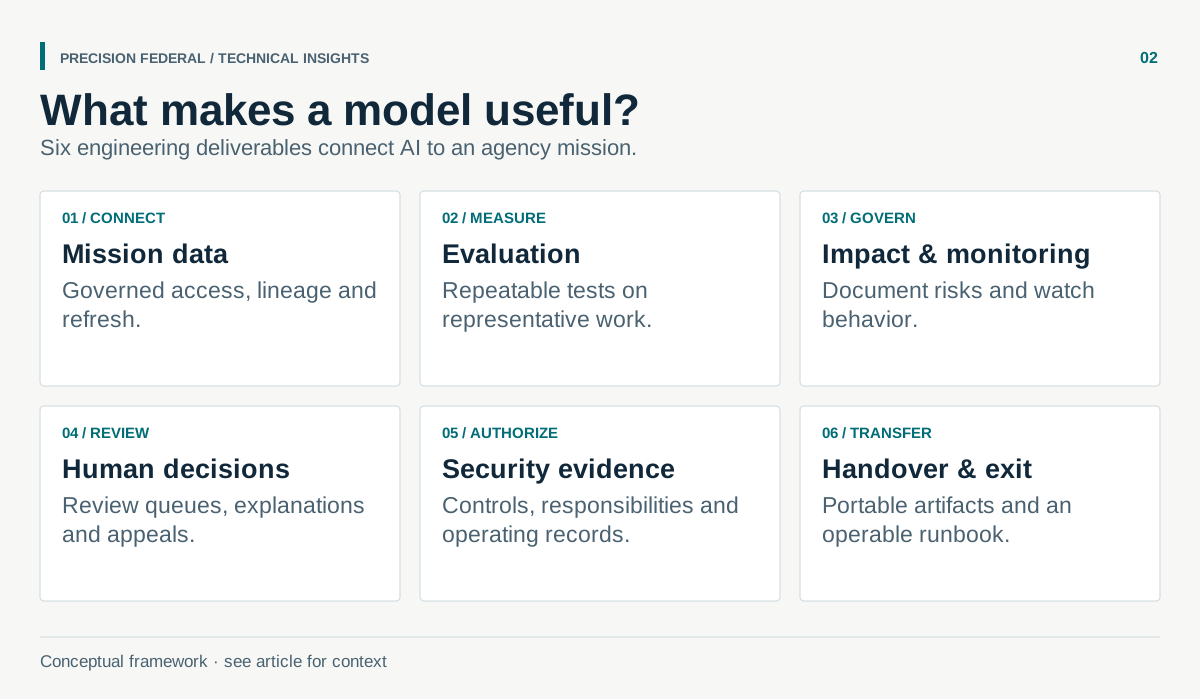
| What is bought | What it looks like when delivered | Why it is required now |
|---|---|---|
| A data pipeline into mission systems | Governed access to the agency's own records, with lineage and refresh | Most listed use cases are pre-deployment because the data work is not done |
| An evaluation harness | Measured accuracy, error and drift on the agency's data, repeatable on demand | M-25-22 ties performance to mission outcomes, not vendor claims |
| Impact assessment and monitoring | The high-impact minimum practices written into the system and its runbook | 445 high-impact use cases cannot run without them; the inventory fields are blank |
| A human review workflow | A ranked queue, a decision point, an audit trail and an appeal path | SSA, IRS and DHS all state that a person decides; the system must show it |
| An authorization package | Controls inherited from the platform, the rest engineered in from the first commit | A model with no authorization to operate is a demonstration, not a deployment |
| A transition and exit plan | Code, artifacts, fine-tuning data and documentation the agency owns and can hand to another team | M-25-22 requires exit provisions and government rights to outputs and artifacts |
How Precision Federal fits
Precision Federal builds that system. Our engineers deliver the data engineering, the evaluation, the application and API layer, the security engineering that carries a system through authorization, and the cloud platform underneath it on AWS GovCloud, Azure Government or Google Cloud Assured Workloads. We build on the agency's own data, measure before we deliver, and hand over something the agency's operations team can run without us. For a commercial company taking a product into government, we build the government edition: the authorization package, the data handling, the accessibility work and the integration an agency requires, on top of the product the company already has.
If the tour above describes your program office, your agency, or the market you are entering, our capabilities pages describe the work in more detail, and a short note about the program is the fastest way to start.
Bottom line
The 2025 inventory says the federal government has identified more than 3,600 places to use AI, has designated 445 of them as consequential, and has built well under half of what it has listed. The models are now supplied on shared terms. The rules for buying the rest were rewritten in April 2025 and took effect on new solicitations at the end of September 2025. What every agency in this tour is buying in 2026 is the same thing: the engineered system, with its evidence, that turns a listed use case into one that runs.
Frequently asked questions
Each agency publishes its own inventory on its website under the Advancing American AI Act, Executive Order 13960 and OMB memorandum M-25-21. OMB consolidates them once a year; the 2025 consolidation was published in April 2026 and is available as a dataset on GitHub under the OMB organization.
For 2025: Health and Human Services with 447, NASA with 425, Veterans Affairs with 367, Energy with 340 and Justice with 314, as reported by Nextgov from the consolidated inventory. VA has the most high-impact use cases, 215 of the 445 government-wide.
It varies by agency, and the inventories say so. At DOT, 53 of 70 are pre-deployment. At CMS, 55 percent are. At FDA, 63 percent are deployed. Across the government a large share of listed use cases are still being built, which is why the inventory is a forecast of purchases as much as a record of them.
Under M-25-21, a high-impact use case must meet minimum practices before and during use, including testing before deployment, an impact assessment, ongoing monitoring, human oversight and a way for affected people to appeal. Those are engineering deliverables, and a system built for a high-impact use has to carry them.
Not their national security systems. Those are exempt from public reporting, so the public inventory understates both. The public signal from the defense side comes from enterprise platforms such as GenAI.mil, from published solicitations and from program offices directly.
OMB memorandum M-25-22, issued April 3, 2025, applies to contracts under solicitations issued on or after September 30, 2025. It directs agencies to require transparency about training data and models, government rights to outputs and fine-tuning artifacts, exit provisions against lock-in, and performance measured against mission outcomes.
Filter it by the problem your product already solves, then by development stage. A pre-deployment use case in your category is an agency that has decided it wants what you do and has not yet built it. The purchase that follows is usually the government edition of the product: authorization, data handling, accessibility and integration, built to the rules above.